Alpha lipoic acid is one of the few antioxidants your body makes for itself. Every cell that burns fuel for energy uses a little of it, and it has been studied for decades for its effects on blood sugar, nerve health and oxidative stress.
This guide covers what alpha lipoic acid is, where you find it in food, what researchers have looked at, the amounts used in studies and the safety points worth knowing before you take it in a supplement.
What alpha lipoic acid is
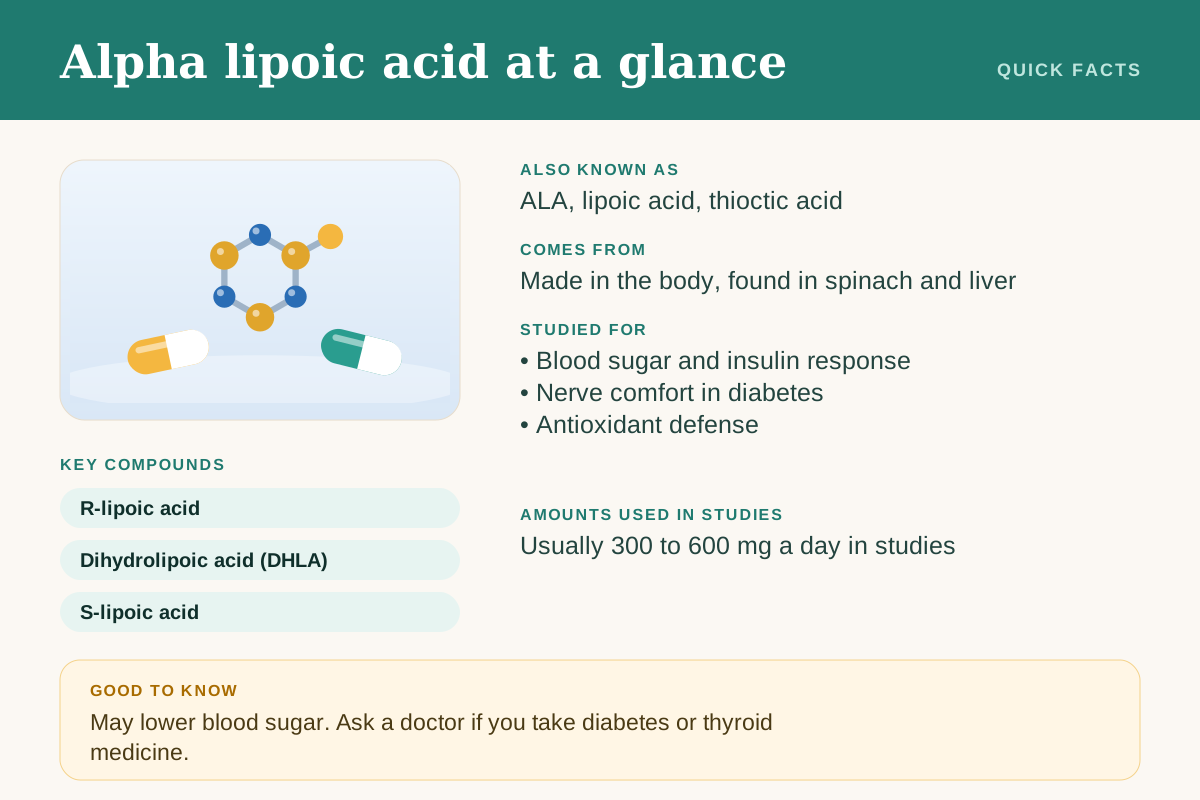
Alpha lipoic acid (often shortened to ALA, and sometimes called lipoic acid or thioctic acid) is a small sulfur-containing compound. Your liver and other tissues make it in tiny amounts, and it works inside the mitochondria, the parts of the cell that turn glucose and fat into usable energy. There it is attached to enzymes that help move fuel through the energy cycle. Without it, those enzymes can't do their job.
Scientists identified lipoic acid in the early 1950s while studying how bacteria and animal cells process energy. It got attention later for a second reason: it acts as an antioxidant in both watery and fatty parts of the body. Most antioxidants work in one or the other. Vitamin C stays in fluids, and vitamin E stays in fats and cell membranes. Alpha lipoic acid can do both.
Please don't confuse it with alpha-linolenic acid, the omega-3 fat found in flaxseed and walnuts. Both get shortened to ALA on labels, but they are completely different nutrients.
Where it comes from
Healthy people make enough alpha lipoic acid for basic energy needs, so it isn't classed as an essential nutrient and there is no recommended daily intake. Food adds a little more. In food it is bound to protein, which is a different form from the free alpha lipoic acid sold in capsules, and the amounts in a normal diet are far smaller than the amounts used in research.
| Food | What to know |
|---|---|
| Organ meats (kidney, heart, liver) | Among the best animal sources, since these organs are packed with mitochondria |
| Spinach | One of the better plant sources |
| Broccoli | Contains small amounts along with fiber and vitamin C |
| Tomatoes | A modest plant source |
| Brussels sprouts and peas | Small amounts |
| Rice bran | Small amounts, often listed in nutrition references |
Supplements usually contain a mix of two mirror-image forms, R-lipoic acid and S-lipoic acid. The R form is the one your body makes naturally. Some products sell R-lipoic acid on its own, but most research has used the standard mixed form.
How it works in the body
Alpha lipoic acid has two jobs. The first is the energy work described above: it helps enzymes in the mitochondria break down the products of glucose and fat so cells can make ATP, their energy currency.
The second job is antioxidant defense. Once inside a cell, alpha lipoic acid is converted to dihydrolipoic acid (DHLA), and the two forms pass electrons back and forth. This pair can neutralize some reactive molecules directly. It also helps regenerate other antioxidants, including vitamin C, vitamin E and glutathione, so they can be used again. Researchers sometimes describe it as an antioxidant that recycles other antioxidants.
Lab and animal research also suggests alpha lipoic acid may affect how cells take up glucose. In muscle cells it appears to help move glucose transporters to the cell surface, which is one reason it has been studied in people with high blood sugar.
What it has been studied for
Blood sugar and insulin response
Blood sugar is the area with the most research. Several clinical trials in adults with type 2 diabetes or prediabetes have looked at whether alpha lipoic acid supplements change fasting glucose, insulin sensitivity or HbA1c (the three-month average blood sugar marker). Results vary from study to study. Some trials found modest improvements in insulin sensitivity and fasting glucose, while others found little change. Reviews that pool these trials generally conclude that it may support healthy glucose metabolism, with effects that are small and best seen alongside diet, exercise and any medicine a doctor has prescribed.
Nerve comfort in people with diabetes
High blood sugar over many years can damage nerves, especially in the feet and legs. This is called diabetic neuropathy, and it causes burning, tingling and numbness. Alpha lipoic acid has been studied for this more than for anything else. In Germany it has a long history of medical use for neuropathy symptoms, sometimes given by IV drip. Trials of oral doses, often 600 mg a day, have reported some relief of symptoms for some participants, though not every study agrees and longer trials have shown mixed results.
Heart health and cholesterol
Because oxidative stress and blood sugar both affect blood vessels, researchers have also looked at alpha lipoic acid and heart health. Small studies have measured blood vessel function, inflammation markers and blood lipids. The findings for cholesterol and triglycerides are mixed, and no one should expect it to change a lipid panel on its own. Its appeal for heart health comes mostly from its antioxidant activity and its possible support for healthy blood sugar, two things that matter for blood vessels over time.
Weight management
A handful of trials have tested alpha lipoic acid in adults trying to lose weight. Some found small differences in body weight compared with placebo over several months. The effect, where it appeared, was modest, so it is best thought of as a small helper next to eating habits and activity.
Amounts used in research
Since your body makes alpha lipoic acid and food supplies only small amounts, studies use supplement doses. These are the ranges you will see most often:
- 300 to 600 mg a day is the most common range in blood sugar and general antioxidant studies.
- 600 mg a day is the dose used most often in nerve studies.
- Some studies have used up to 1,200 or 1,800 mg a day for shorter periods.
Food appears to reduce how much alpha lipoic acid the body absorbs, which is why many product labels suggest taking standalone supplements on an empty stomach. Combination formulas are a different matter, so follow the directions on the product you use.
Safety and who should ask a doctor
At the amounts used in studies, alpha lipoic acid has a good safety record in healthy adults. The most common complaints are mild: nausea, heartburn, stomach upset and, less often, a skin rash.
A few points are worth knowing:
- It may lower blood sugar. If you take insulin or another diabetes medicine, talk with your doctor first and keep checking your glucose, since the combination could push levels too low.
- It may affect thyroid hormone levels or how thyroid medicine works, so people being treated for thyroid conditions should check with their doctor.
- People having chemotherapy should ask their oncologist before taking any antioxidant supplement.
- People who are low in thiamine (vitamin B1), which can happen with heavy alcohol use, should talk to a doctor before taking it.
- There isn't enough research on use during pregnancy or breastfeeding, so it is wise to avoid supplements during that time unless your doctor says otherwise.
A rare condition called insulin autoimmune syndrome, which causes episodes of low blood sugar, has been reported in a small number of people taking alpha lipoic acid. It has mostly been seen in people with a particular genetic background. It is uncommon, but it is another reason to mention any supplement to your doctor.
Why it's in the ColestZen formula
ColestZen is built around ingredients studied for healthy blood sugar, heart and metabolic health, and alpha lipoic acid fits that goal well. It works at the most basic level of metabolism, inside the mitochondria where glucose and fat are burned. It also supports the body's antioxidant system, including the vitamin C and vitamin E that are in the same formula.
It also sits comfortably next to the plant ingredients in the blend. Cinnamon, bitter melon, gymnema and banaba leaf have each been studied for blood sugar, and minerals such as chromium and magnesium support normal glucose metabolism. Alpha lipoic acid adds an antioxidant that works in both watery and fatty tissues, which none of the herbs do in quite the same way.
The brand doesn't list how much of each ingredient is in a capsule, so there is no way to compare the ColestZen amount with research doses. If you want to see how all 18 ingredients work together, along with price, guarantee and our rating, read our full ColestZen review.
Tips for using alpha lipoic acid well
A supplement works best as part of a routine. If blood sugar and heart health are your goals, the basics still matter most: meals built around vegetables, beans, whole grains and lean protein, regular walks or other movement, and enough sleep. Take your supplement at the same time each day so you don't forget it, and give it a few months before judging how you feel. Keep your doctor in the loop, especially if you have regular blood work, so changes can be tracked properly.
Frequently asked questions
Is alpha lipoic acid the same as the omega-3 ALA?
No. Alpha lipoic acid is a sulfur-containing antioxidant your body makes for energy production. Alpha-linolenic acid is an omega-3 fat from foods like flaxseed and walnuts. Both are abbreviated ALA, so check the full name on the label.
Can I get enough alpha lipoic acid from food?
Your body makes what it needs for basic energy work, and foods like spinach, broccoli and organ meats add a little. The amounts used in studies, usually 300 to 600 mg a day, are much higher than any normal diet provides, which is why research uses supplements.
Does alpha lipoic acid lower blood sugar?
It has been studied for blood sugar, and some trials found modest improvements in insulin sensitivity and fasting glucose. Results vary. Because it may lower blood sugar, people on diabetes medicine should talk to their doctor before taking it.
Are there side effects?
Most people tolerate it well. The most common side effects are nausea, heartburn or stomach upset, and occasionally a skin rash. Ask your doctor first if you are pregnant, take diabetes or thyroid medicine, or are having cancer treatment.
Sources
- Linus Pauling Institute Micronutrient Information Center: Lipoic acid
- MedlinePlus: Alpha-lipoic acid
- NCCIH: Diabetes and dietary supplements
This guide is for general information and is not medical advice. Talk to your doctor before starting any supplement, especially if you take medication.