Banaba is a flowering tree that lines streets and riverbanks across the Philippines, India and much of Southeast Asia. In summer it is covered in pink and purple blossoms, which is why gardeners call it the queen's crape myrtle. For generations, Filipino families have dried its leaves and brewed them into a tea that elders drank to help keep their sugar levels in check.
Researchers became curious about that habit in the late twentieth century, and banaba leaf extract is now one of the better known botanicals for blood sugar support. This article covers where banaba comes from, what scientists have looked at so far, how its main compound seems to work, sensible safety points, and why it was chosen for the ColestZen formula.
What banaba leaf is
The banaba tree has the botanical name Lagerstroemia speciosa. It belongs to the loosestrife family, the same group as the crape myrtles planted in yards across the American South. A mature tree can reach 30 feet or more, with smooth peeling bark, large oval leaves and clusters of ruffled flowers. In the fall the leaves turn orange and red before they drop, and older, yellowed leaves are the ones traditionally gathered for tea.
The tree is native to tropical Asia and grows well in hot, humid places with plenty of rain. In the Philippines it is so common that the word banaba is used for both the tree and the tea. It is also grown as an ornamental in India, Vietnam, Malaysia and parts of southern China, and you can find it in warm regions of Florida and Hawaii as a decorative shade tree.
Traditional use
Folk healers in the Philippines used banaba leaves for many complaints, including water retention and kidney troubles, but the use that drew the most attention was for people who passed a lot of sugar in their urine. The usual method was simple: a handful of dried leaves simmered in water, strained, and sipped through the day. Some households still keep a jar of dried leaves next to the kettle.
Traditional use does not prove that a plant works. It does tell researchers where to look, and in banaba's case it pointed them toward a few compounds in the leaf that act on how the body handles glucose.
What is inside the leaf
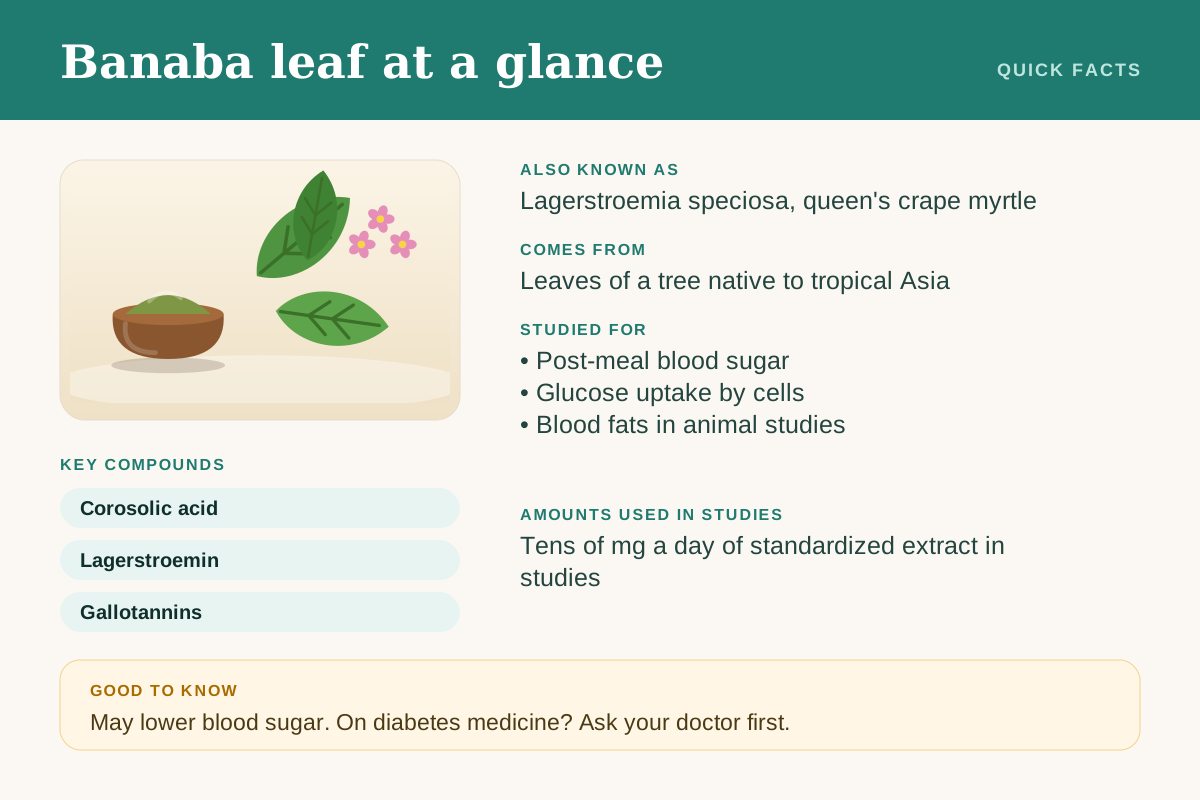
The compound most people associate with banaba is corosolic acid, a natural triterpene. Commercial banaba extracts are often standardized to contain a set percentage of corosolic acid so that each batch is more consistent. Corosolic acid is also found in smaller amounts in a few other plants, including loquat leaves and some varieties of apple peel.
Banaba leaves also contain ellagitannins, a group of polyphenols. One of them, lagerstroemin, has been studied in the lab for its effects on how cells take in glucose. The leaves have gallotannins and flavonoids too, which act as antioxidants.
| Compound | Type | What it has been studied for |
|---|---|---|
| Corosolic acid | Triterpene | Glucose uptake into cells and post-meal blood sugar |
| Lagerstroemin | Ellagitannin | Insulin-like activity in lab studies |
| Gallotannins | Polyphenols | Antioxidant activity and starch digestion in the lab |
| Flavonoids | Polyphenols | General antioxidant support |
What banaba has been studied for
Most of the research on banaba focuses on blood sugar. In small human studies, people who took a banaba extract or purified corosolic acid before a meal or a glucose drink tended to have a smaller rise in blood sugar afterward than when they took a placebo. A few studies lasting several weeks also looked at fasting blood sugar in adults whose levels were higher than ideal, with encouraging results.
These studies were usually small and short, and many used different extracts at different strengths, so they are hard to compare directly. Scientists describe banaba as promising and in need of larger, longer trials. That is a fair way to see it: a plant with a long history of use, a plausible way of working, and early human data that supports a closer look.
Animal and lab studies have also looked at banaba and corosolic acid for blood fats, body weight and inflammation markers. Some of these found improvements in triglycerides and cholesterol in animals fed high-fat diets. Results in animals do not always carry over to people, so these findings are best seen as reasons for more research. Because high blood sugar, weight gain and unhealthy cholesterol often show up together in midlife, a plant studied across several of these areas is a sensible fit for a broad metabolic formula.
How banaba may work in the body
After a meal, your body breaks carbohydrates down into glucose, which enters the bloodstream. Insulin then signals your muscle and fat cells to move glucose transporters, called GLUT4, to the cell surface so glucose can get inside and be used for energy. When cells respond less well to insulin, glucose stays in the blood longer.
Lab research suggests corosolic acid may help with the step where GLUT4 moves to the cell surface, which is why it is sometimes described as having insulin-like activity. Other studies suggest compounds in banaba may slow some of the enzymes that break down starch and sugar in the gut, so glucose enters the blood more gradually. Some of the tannins also appear to act on fat cells in lab dishes. Researchers are still working out how much each of these effects matters in a living person, but together they help explain the post-meal results seen in human studies.
Amounts used in studies
Banaba research has mostly used concentrated extracts in capsules. Human studies have typically used small daily amounts of extract, often in the range of tens of milligrams, standardized to contain a set percentage of corosolic acid. Some trials gave purified corosolic acid on its own in even smaller amounts, usually taken shortly before a meal.
Because extracts vary so much in strength, a milligram figure on one label cannot be compared directly with another. ColestZen does not publish the amount of each ingredient per capsule, so the best approach is to follow the label directions of whatever product you use and talk with your doctor if you take other blood sugar products.
Safety and who should ask a doctor
In the short studies published so far, banaba extract was generally well tolerated. Reported side effects have been mild and uncommon, such as an upset stomach. A few points are worth keeping in mind.
- Banaba may lower blood sugar. If you take metformin, insulin, a sulfonylurea or any other diabetes medicine, ask your doctor before adding it, since the combination could push your levels too low. Watch for shakiness, sweating or sudden hunger.
- There is not enough safety research in pregnancy or while breastfeeding, so it is best avoided during those times.
- People with kidney disease should talk to their doctor first, as there is little research on banaba in that group.
- If you have surgery scheduled, mention any blood sugar supplements to your care team, since blood sugar control matters around procedures.
None of this is meant to worry you. Banaba has been used as a tea for a very long time, and most healthy adults tolerate it well. The goal is simply to keep your doctor in the loop, especially if you already manage blood sugar with medication.
Why banaba is in the ColestZen formula
ColestZen is a two-capsule daily supplement with 18 ingredients chosen to support healthy cholesterol, blood sugar and overall metabolic health. Banaba leaf fits the blood sugar side of that plan. It sits alongside other botanicals with a history of use for glucose support, such as cinnamon bark, bitter melon and gymnema sylvestre, plus nutrients like chromium and alpha lipoic acid.
Each of these works through a slightly different route. Banaba's corosolic acid is studied for how cells take in glucose, gymnema is studied for sugar absorption and taste, and chromium helps insulin do its job. Combining ingredients that act at different points is a common approach in metabolic formulas. If you would like to see how all 18 ingredients work together, along with pricing, the 60-day money-back guarantee and what real buyers say, read our full ColestZen review.
Simple ways to support healthy blood sugar
Banaba works best as one part of a healthy routine. A short walk after your largest meal of the day helps your muscles pull glucose out of the blood. Building meals around vegetables, beans, lentils, whole grains and lean protein slows how fast sugar reaches your bloodstream. Swapping sweet drinks for water or unsweetened tea makes a real difference over a few months, and getting seven or more hours of sleep helps your body respond to insulin.
If you are curious how these habits are working for you, ask your doctor about an A1C test, which reflects your average blood sugar over roughly the past three months. Checking it once or twice a year gives you a clear picture of where you stand and whether your routine is paying off.
Frequently asked questions
What does banaba leaf do for the body?
Banaba leaf has mainly been studied for blood sugar. Its best known compound, corosolic acid, may help cells take in glucose after a meal. Small human studies are encouraging, but larger trials are still needed.
Is banaba leaf safe to take every day?
Short studies found banaba extract was generally well tolerated by healthy adults. Because it may lower blood sugar, people on diabetes medication should ask their doctor first. It is best avoided during pregnancy and breastfeeding.
Can I drink banaba tea instead of taking a capsule?
Yes, banaba tea made from dried leaves is a traditional drink in the Philippines. Tea strength varies a lot, though, and most research used standardized extracts, so a capsule gives a more consistent amount.
How much banaba is in ColestZen?
The brand does not publish the amount of each ingredient per capsule. ColestZen is taken as two capsules a day, and banaba leaf is one of its 18 ingredients for blood sugar and metabolic support.
Sources
- NCCIH: Diabetes and dietary supplements
- Memorial Sloan Kettering Cancer Center, About Herbs: Banaba
- Published small human trials on banaba extract and corosolic acid
This guide is for general information and is not medical advice. Talk to your doctor before starting any supplement, especially if you take medication.