Chromium is a mineral most people never think about. You need only a tiny amount each day, yet scientists have studied it for decades because of the way it works with insulin, the hormone that keeps blood sugar in a healthy range.
This guide covers what chromium is, what it has been studied for, how much adults need, which foods supply it and who should check with a doctor before taking it as a supplement. You will also see why it is one of the 18 ingredients in ColestZen.
What chromium is
Chromium is a trace mineral, which means your body needs it in very small amounts. It is measured in micrograms (mcg), or millionths of a gram, so a whole day's worth would be invisible on a teaspoon. It is found in soil and rock, and it reaches your plate through vegetables, grains, meat and even dried herbs.
There are two main forms, and they are very different. Trivalent chromium (often written chromium 3) is the form in food and dietary supplements. Hexavalent chromium (chromium 6) is an industrial pollutant from processes such as chrome plating and welding, and it is toxic. When a food label or supplement panel lists chromium, it always means the trivalent form.
Scientists still debate how essential chromium is. In the United States, the Food and Nutrition Board of the National Academies set an Adequate Intake for it in 2001, and that figure is still the one American nutrition guidance uses. Some European regulators have questioned whether it is strictly essential, which tells you the science is still moving.
How chromium works with insulin
After a meal, insulin moves glucose out of your bloodstream and into your cells, where it is burned for energy or stored for later. Chromium appears to help insulin do that job. Researchers think it works through a small molecule, sometimes called chromodulin, that binds chromium and helps the insulin receptor on each cell pass its signal along more strongly.
Much of the early interest came from hospital patients who were fed only through an IV line, before chromium was routinely added to those feeding solutions. Some of them developed high blood sugar and nerve problems that improved once chromium was given. Those cases put chromium on the map for anyone studying blood sugar control.
Chromium also takes part in how the body handles fats and protein. That is one reason it appears in research on cholesterol and body weight as well as blood sugar.
What chromium has been studied for
Blood sugar and insulin sensitivity
Most chromium research looks at blood sugar. Many clinical trials have tested chromium supplements in adults with type 2 diabetes or prediabetes, measuring fasting glucose, insulin levels and HbA1c, a marker of average blood sugar over roughly three months. Some trials and reviews report modest improvements, especially in people whose blood sugar was less well controlled at the start. Others found little change. The NIH Office of Dietary Supplements describes the overall evidence as inconsistent, which is a fair summary: chromium may support healthy glucose metabolism for some people, and researchers are still working out who benefits most.
Part of the puzzle is that people start from different places. There is no simple, reliable blood test for chromium status, so a trial cannot easily separate people who were low in chromium from people who already had plenty. A person who is short on a nutrient usually responds more to a supplement than someone who is not.
Cholesterol and blood fats
Some chromium studies have measured blood lipids along with blood sugar. A few reported small changes in total cholesterol, LDL cholesterol or triglycerides, while others found no difference. Because insulin function and blood fats tend to move together, researchers continue to look at chromium as part of the wider picture of metabolic and heart health.
Weight, appetite and cravings
Chromium picolinate has been sold as a weight loss aid for years. Reviews of the trials suggest that any effect on body weight is small. A handful of small studies have looked at carbohydrate cravings and appetite, with some encouraging early findings, though there is not much research yet.
How much chromium you need
US guidelines give an Adequate Intake (AI) for chromium instead of a full Recommended Dietary Allowance, because there was not enough data to set an RDA. The AI is based on how much chromium healthy people typically get from a balanced diet. Needs drop a little after age 50.
| Age group | Men | Women |
|---|---|---|
| 19 to 50 years | 35 mcg a day | 25 mcg a day |
| 51 years and older | 30 mcg a day | 20 mcg a day |
| Pregnancy (19 to 50) | Not applicable | 30 mcg a day |
| Breastfeeding (19 to 50) | Not applicable | 45 mcg a day |
The Daily Value printed on US food and supplement labels is 35 mcg. No upper limit has been set for chromium, because there is little evidence of harm from the amounts in food or typical supplements. That does not make very large doses risk free, as the safety section below explains.
Food sources of chromium
Chromium is spread thinly across many foods, and the amount in any one of them depends on the soil it grew in and how it was processed. That makes exact numbers hard to pin down, but some foods are reliably better than others.
- Broccoli is one of the best vegetable sources, with roughly 11 mcg in half a cup.
- Grape juice and orange juice provide a few micrograms per cup.
- Whole wheat English muffins and whole grain bread add smaller amounts.
- Potatoes, green beans, garlic and dried basil each contribute a little.
- Beef and turkey breast supply small amounts too.
Whole grains generally keep more chromium than refined flour. Diets high in simple sugars can make your body lose more chromium in urine, so cutting back on sweets and white bread helps in two ways. Most adults who eat a varied diet built on whole foods get enough chromium without trying.
Amounts used in studies and supplement forms
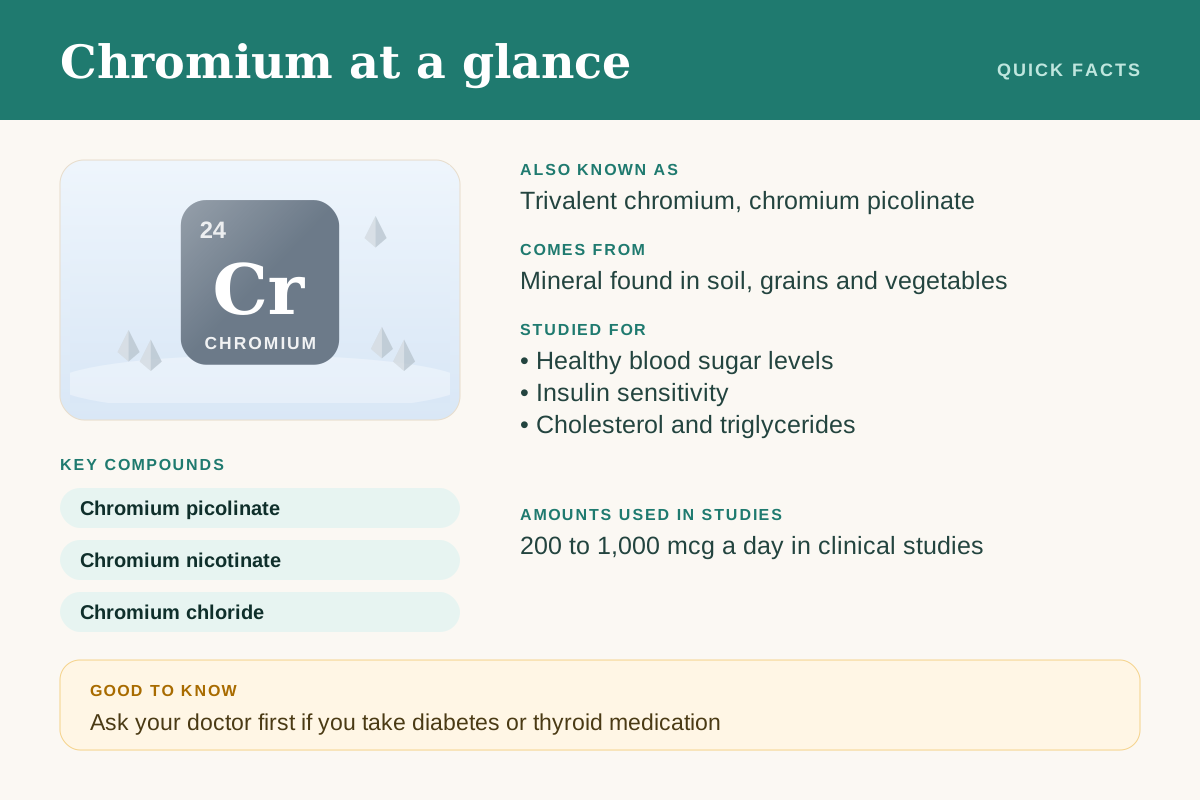
Research doses are far higher than what food provides. Trials in people with blood sugar concerns have commonly used 200 to 1,000 mcg of chromium a day, usually for a few weeks up to several months.
Supplements come in several forms, including chromium picolinate, chromium chloride, chromium nicotinate (sometimes sold as chromium polynicotinate), chromium histidinate and chromium yeast. Chromium picolinate is the most widely studied. Your body absorbs only a small fraction of the chromium you swallow, whatever the source, and some research suggests certain forms are absorbed somewhat better than others. Vitamin C and niacin (vitamin B3) taken at the same time may help absorption.
Many multivitamins also contain chromium, so if you take one, add that amount to anything else you use when you work out your daily total.
Safety and who should talk to a doctor
Chromium from food is considered very safe. Supplements at common doses are usually well tolerated, though some people notice an upset stomach, headache or dizziness. There have been rare reports of kidney or liver problems in people taking high doses, so anyone with kidney or liver disease should speak with a doctor before using a chromium supplement.
A few other points are worth knowing:
- If you take insulin or other diabetes medication, chromium may add to its blood sugar lowering effect. Your doctor may want you to check your glucose more often.
- Chromium may reduce how well your body absorbs levothyroxine, a common thyroid medicine. People are usually advised to take the two several hours apart, so ask your pharmacist about timing.
- Antacids, acid reducers such as proton pump inhibitors, and corticosteroids can change how much chromium you absorb or lose.
- If you are pregnant or breastfeeding, stick to food sources unless your doctor suggests otherwise.
None of this should worry a healthy adult, but a quick conversation with your doctor is always sensible before starting any new supplement, especially if you take prescription medicine.
Why chromium is in ColestZen
ColestZen is a formula aimed at heart and metabolic health, and chromium fits that theme well. Its role in insulin action makes it a natural partner for the plant ingredients in the blend that are also studied for blood sugar, such as cinnamon bark, bitter melon, gymnema sylvestre and banaba leaf. Alpha lipoic acid and magnesium, two more ingredients in the formula, show up in insulin research too, so chromium sits alongside nutrients that were chosen for similar reasons.
The brand does not publish how much chromium each capsule contains, so it is not possible to compare it directly with the doses used in trials. What we can say is that chromium is one of the best known minerals in blood sugar research, and including it makes sense in a formula built around metabolic support. You can see how the whole blend did in our full ColestZen review, which covers the price, the 60-day money-back guarantee and what to expect in the first weeks.
Like any supplement, ColestZen is meant to sit alongside the basics: meals built on vegetables, whole grains and lean protein, regular walks or other exercise, and routine checkups where your doctor tracks your blood sugar and cholesterol.
Frequently asked questions
Is chromium safe to take every day?
For most healthy adults, chromium from food and from supplements at common amounts is well tolerated, and no upper limit has been set. People with kidney or liver disease, and anyone taking diabetes or thyroid medication, should ask their doctor first.
What foods are high in chromium?
Broccoli is one of the better sources, with about 11 mcg in half a cup. Grape juice, whole grains, potatoes, green beans, garlic, beef and turkey add smaller amounts.
Does chromium help with blood sugar?
Chromium helps insulin work, and it has been studied in many trials for blood sugar support. Results have been mixed, with some studies showing modest benefits and others showing little change. It does not replace diabetes care from your doctor.
How much chromium is in ColestZen?
The brand does not list the amount of each ingredient per capsule. Chromium is one of 18 ingredients in the blend, which is taken as 2 capsules a day.
Sources
- NIH Office of Dietary Supplements: Chromium fact sheet for health professionals
- Food and Nutrition Board, National Academies: Dietary Reference Intakes (2001)
- MedlinePlus: Chromium in diet
This guide is for general information and is not medical advice. Talk to your doctor before starting any supplement, especially if you take medication.