You get your blood work back and there it is: a column of numbers labeled LDL, HDL, triglycerides and total cholesterol, with a few of them flagged. Most people remember that one kind is "good" and one is "bad," and that's about where it ends.
This guide walks through what those numbers measure, the standard ranges doctors use for adults, why some doctors also look at ratios and non-HDL cholesterol, and which everyday habits tend to push each number in a better direction. It's written for adults in their late 30s and beyond who want to read their own lipid panel with a bit more confidence.
What lipoproteins are
Cholesterol is a waxy fat your body uses to build cell walls, make hormones like estrogen and testosterone, produce vitamin D and make bile acids for digestion. Your liver makes most of the cholesterol you need, and the rest comes from animal foods such as meat, eggs and dairy.
Fat and water don't mix, so cholesterol can't float freely in your blood. It travels inside small particles called lipoproteins, which have a shell of protein and a core of fat. You can picture them as delivery vehicles moving cholesterol and triglycerides around the body.
When a lab reports "LDL cholesterol" or "HDL cholesterol," it is measuring how much cholesterol is being carried by each type of vehicle. The cholesterol itself is the same molecule in both. What differs is where the vehicle is going and what it tends to do along the way.
How LDL and HDL differ
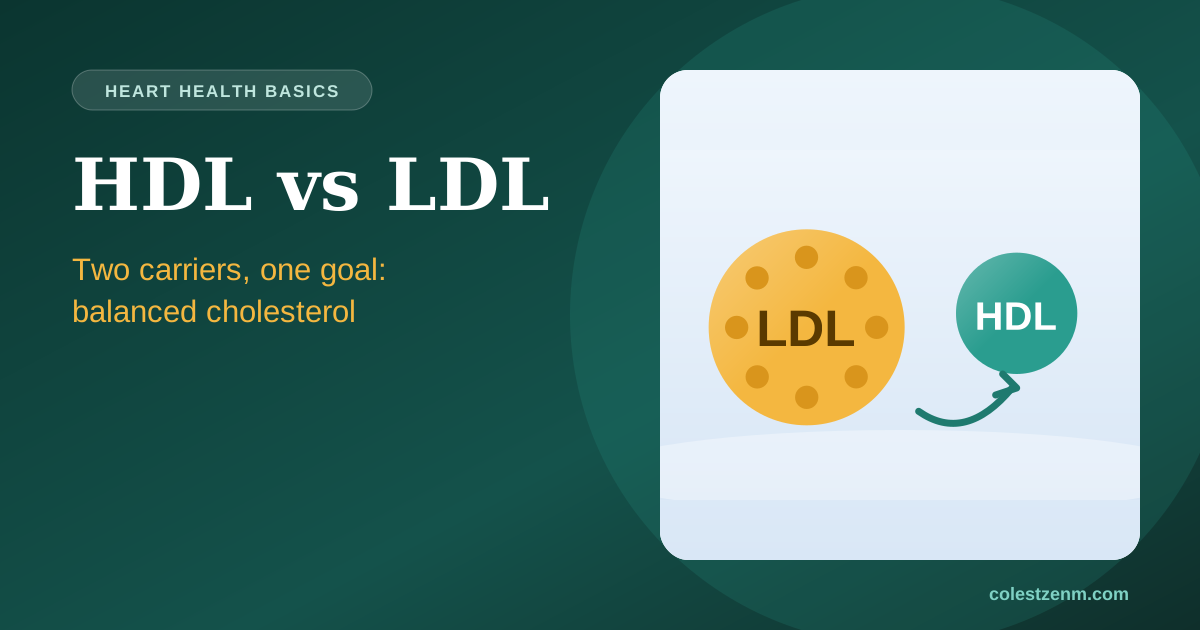
LDL stands for low-density lipoprotein. Its job is to carry cholesterol from the liver out to the tissues that need it. When there is more LDL in the blood than the body can use, some of it can work its way into the walls of arteries. Over years, that cholesterol becomes part of plaque, the buildup that narrows arteries and stiffens them. That is why LDL gets called the "bad" cholesterol.
HDL, or high-density lipoprotein, runs mostly in the other direction. It picks up extra cholesterol from the bloodstream and tissues and brings it back to the liver, which can break it down or clear it out of the body. Higher HDL levels have long been tied to lower heart disease risk in population studies, which earned it the "good" label.
A simple way to think about it: LDL is the delivery truck dropping off packages, and too many trucks on the road means some packages end up stacked against the curb (your artery walls). HDL is the cleanup crew that gathers loose packages and takes them back to the warehouse. You want enough delivery to keep things running and a cleanup crew that can keep up.
The analogy has limits. Researchers now know that HDL is a mixed group of particles, and raising HDL with drugs has not lowered heart risk the way many people hoped. So doctors treat a low HDL as a warning sign worth paying attention to, while LDL remains the main number they track.
Triglycerides and non-HDL cholesterol
Triglycerides are a different kind of fat. They are the main form your body uses to store energy. When you eat more calories than you burn, especially from sugar, refined carbs and alcohol, your liver turns the extra into triglycerides, which are stored in fat cells and released between meals.
High triglycerides often show up alongside low HDL, extra weight around the waist and higher blood sugar. Because of that pattern, doctors usually read the triglyceride number together with the cholesterol numbers instead of on its own. A standard lipid panel often asks you to fast for 9 to 12 hours beforehand, mainly because a recent meal can raise triglycerides for a while.
Non-HDL cholesterol is a simple calculation: your total cholesterol minus your HDL. It captures the cholesterol carried by LDL plus the other particles that can contribute to plaque, such as VLDL (very low-density lipoprotein, which carries triglycerides). You can work it out from your lab report in a few seconds. Many doctors like it because it gives a fuller picture of the particles that can end up in artery walls.
Standard target ranges for adults
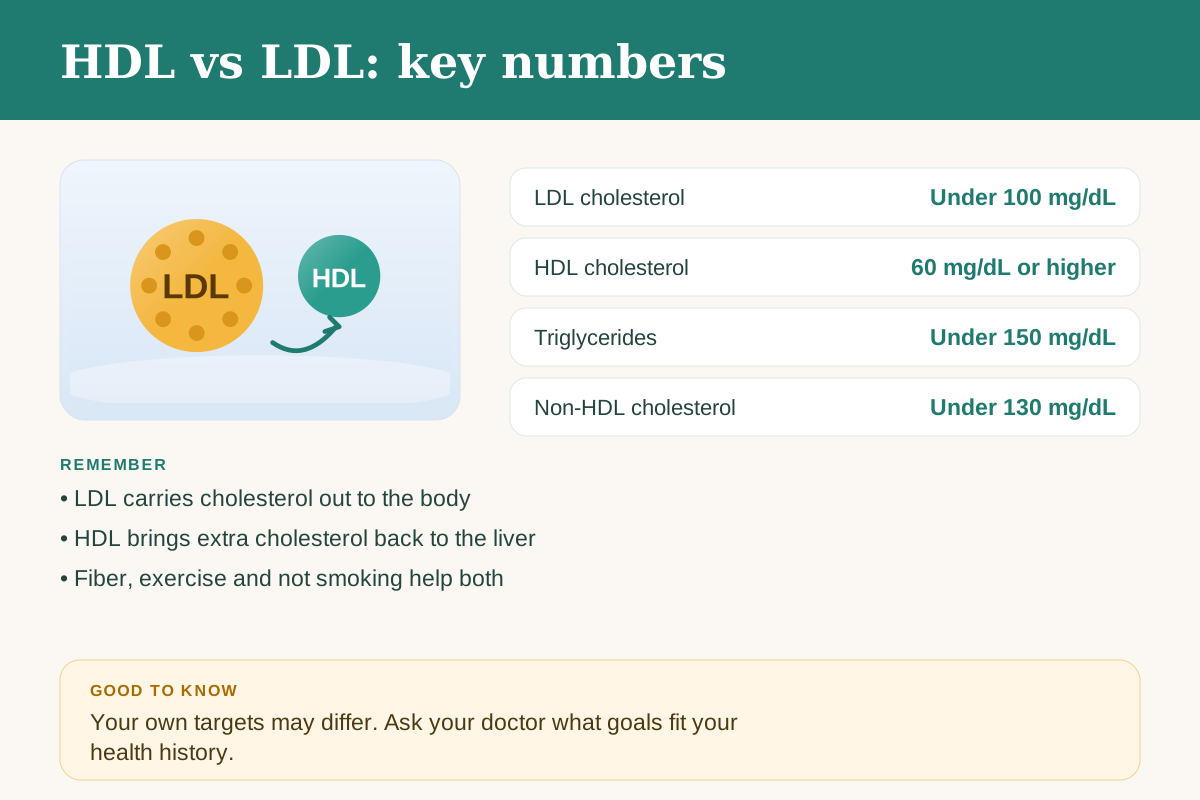
The ranges below are the general adult reference values used by MedlinePlus and the National Heart, Lung, and Blood Institute (NHLBI). Your own targets may be different. A person who already has heart disease or diabetes, for example, is often given a lower LDL goal, and your doctor will also weigh your age, family history, blood pressure and smoking status.
| Measurement | General adult target | What a higher number usually means |
|---|---|---|
| Total cholesterol | Under 200 mg/dL | 200 to 239 is borderline high; 240 or more is high |
| LDL cholesterol | Under 100 mg/dL (optimal) | 130 to 159 is borderline high; 160 to 189 is high; 190 or more is very high |
| HDL cholesterol | 60 mg/dL or higher is best | Here lower is the concern: under 40 mg/dL is considered low |
| Triglycerides | Under 150 mg/dL | 150 to 199 is borderline high; 200 to 499 is high; 500 or more is very high |
| Non-HDL cholesterol | Under 130 mg/dL | Your doctor will interpret this along with your LDL |
Notice that HDL is the one number on the panel where higher is the goal. An LDL of 100 to 129 is called near optimal.
Why doctors talk about ratios
For years, people were told to look at the ratio of total cholesterol to HDL, or of LDL to HDL. The idea makes sense: if the cleanup crew is large compared with the overall traffic, the system is in better balance. Two people can have the same total cholesterol of 210 mg/dL, but if one has an HDL of 65 and the other has an HDL of 35, their risk pictures look quite different.
Ratios are a handy shorthand, but current guidance mostly focuses on each number by itself, with LDL and non-HDL at the center, combined with your other risk factors. A ratio can hide useful detail. A "good" ratio built on a very high HDL might mask an LDL that deserves attention on its own. Use ratios as a talking point with your doctor, and look at the individual numbers first.
Lifestyle habits that tend to lower LDL
Food choices move LDL more than most people expect. The biggest levers are what kind of fat you eat and how much soluble fiber you get.
- Swap saturated fat for unsaturated fat. Saturated fat, found in fatty cuts of red meat, butter, cheese, cream and many baked goods, tends to raise LDL. Olive oil, canola oil, avocados, nuts, seeds and fatty fish such as salmon and sardines are better everyday choices.
- Avoid trans fats. Partially hydrogenated oils raise LDL and lower HDL at the same time. They have largely been removed from the US food supply, but it's still worth reading labels on older or imported packaged snacks.
- Eat more soluble fiber. Oats, barley, beans, lentils, apples, pears, citrus fruit and psyllium form a gel in the gut that binds some cholesterol and bile acids so your body removes them. A bowl of oatmeal at breakfast and a cup of beans in a lunch soup or salad make a real difference over a day.
- Lose a little weight if you carry extra. Even a modest loss can bring LDL and triglycerides down, especially when the weight comes off the waistline.
Lifestyle habits that tend to raise HDL
HDL is harder to move than LDL, and genetics account for a lot of it. Even so, several habits nudge it upward, and most of them help triglycerides too.
Regular exercise is the most reliable. The federal physical activity guidelines suggest at least 150 minutes a week of moderate activity, such as brisk walking, cycling or swimming, which works out to about 30 minutes on five days. Aerobic exercise tends to raise HDL modestly and lower triglycerides, and adding two days of strength training helps with weight and blood sugar.
If you smoke, quitting is one of the best things you can do for your HDL. Smoking lowers HDL and damages the lining of blood vessels, which makes it easier for LDL to get into artery walls. HDL tends to rise after people quit, and the heart benefits keep adding up for years.
Cutting back on sugar, white bread, sweet drinks and alcohol helps the triglyceride number in particular, and lower triglycerides often go along with better HDL. Losing extra weight helps here as well.
HDL vs LDL at a glance
| LDL cholesterol | HDL cholesterol | |
|---|---|---|
| Full name | Low-density lipoprotein | High-density lipoprotein |
| Main job | Carries cholesterol from the liver to the body | Carries extra cholesterol back to the liver |
| Common nickname | "Bad" cholesterol | "Good" cholesterol |
| General adult target | Under 100 mg/dL | 60 mg/dL or higher |
| Main concern | Too high | Too low (under 40 mg/dL) |
| Habits that help | Less saturated fat, more soluble fiber, weight loss | Regular exercise, not smoking, weight loss, fewer refined carbs |
Where a supplement like ColestZen fits
Diet, movement, sleep and not smoking come first, and if your doctor has prescribed a medication, that stays in place. Supplements sit on top of those basics as an extra layer of support.
ColestZen is a daily formula of 18 ingredients, taken as two capsules a day, designed to support healthy cholesterol and blood sugar levels that are already in the normal range. It brings together botanicals such as cinnamon bark, bitter melon, gymnema and banaba leaf with nutrients like alpha lipoic acid, chromium, magnesium, vitamin C and vitamin E. Several of those ingredients have been studied for blood sugar and metabolic health, which matters here because blood sugar and triglycerides often travel together. It comes with a 60-day money-back guarantee, so you have time to see how it fits into your routine.
If you take medication for cholesterol, blood pressure or diabetes, check with your doctor before adding any supplement, because some ingredients can lower blood sugar. The full ingredient list, pricing and our honest take are in our full ColestZen review. Keep getting your lipid panel checked on schedule, since those numbers are the clearest way to see how your habits are paying off.
Frequently asked questions
Is a high HDL always a good thing?
In most people, an HDL of 60 mg/dL or higher is a good sign. Very high HDL levels are less clearly helpful, and HDL can't cancel out a high LDL. Your doctor will look at all of your numbers together, along with your other risk factors.
Do I need to fast before a cholesterol test?
Many labs ask you to fast for 9 to 12 hours before a lipid panel, mainly because a recent meal raises triglycerides. Some doctors now accept non-fasting tests for routine checks. Follow the instructions your doctor or lab gives you.
How do I calculate my non-HDL cholesterol?
Take your total cholesterol and subtract your HDL. For example, a total cholesterol of 190 mg/dL with an HDL of 55 mg/dL gives a non-HDL of 135 mg/dL. For most adults, the general target is under 130 mg/dL.
How fast can lifestyle changes improve my numbers?
LDL and triglycerides can start to shift within a few weeks of steady changes in diet and activity, while HDL usually moves more slowly. Many doctors recheck a lipid panel a few months after you start new habits to see the trend.
Sources
- MedlinePlus: Cholesterol levels: what you need to know
- MedlinePlus: Cholesterol levels (lab test)
- National Heart, Lung, and Blood Institute: ATP III at a glance, classification of LDL, total and HDL cholesterol and triglycerides
- National Heart, Lung, and Blood Institute: Blood cholesterol
- CDC: About cholesterol
- US Department of Health and Human Services: Physical Activity Guidelines for Americans
- American Heart Association: HDL (good), LDL (bad) cholesterol and triglycerides
This guide is for general information and is not medical advice. Talk to your doctor about your own numbers and treatment.