
Most people know juniper berries from one place: a glass of gin. Those small, dusty blue berries give gin its sharp, piney flavor. Long before gin existed, though, juniper was a kitchen spice and a household remedy across Europe, Asia and North America.
Healers used it for digestion, for the urinary tract and as a warming tonic. Research in people is still thin, so this article focuses on what is well known about juniper: where it comes from, how it has been used, what scientists have started to study, and the safety points everyone should know before taking it.
What juniper berries are
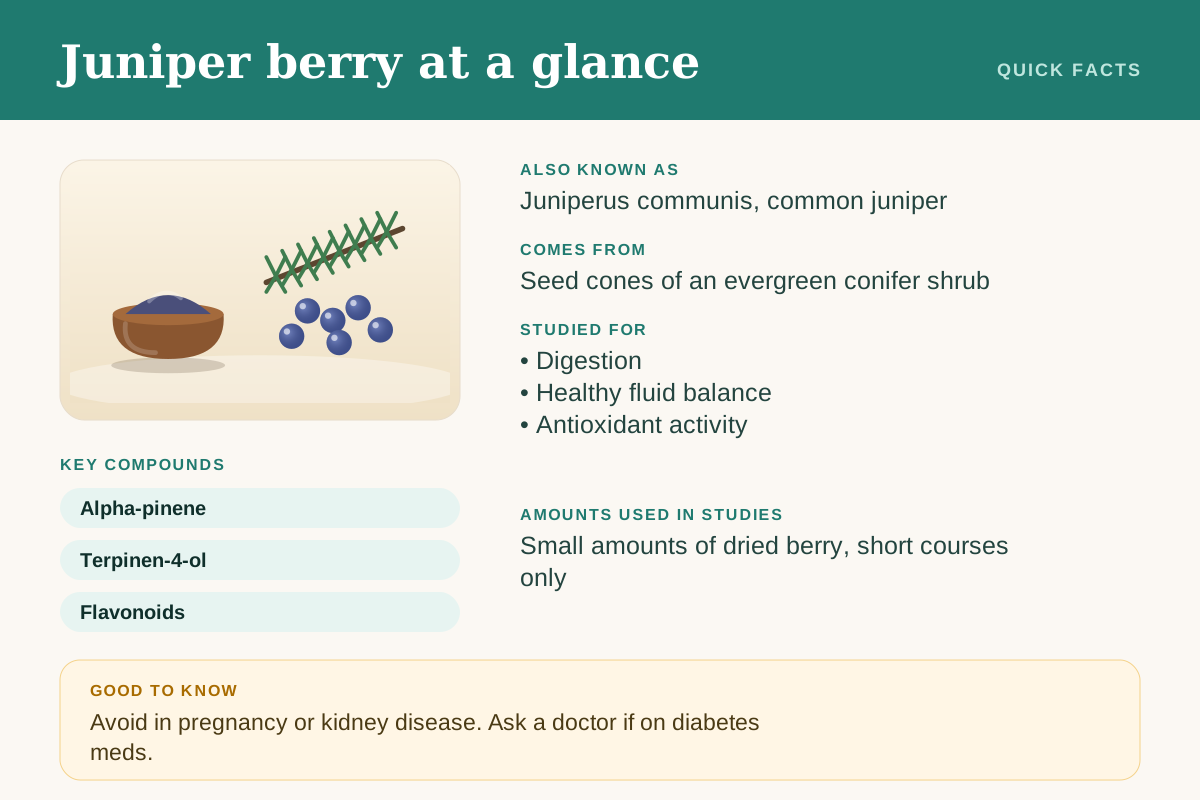
The juniper used in food and herbal medicine is common juniper, Juniperus communis. It is an evergreen conifer that grows as a low spreading shrub or a small tree, with short, sharp needles. Common juniper has one of the widest natural ranges of any woody plant, stretching across the cooler parts of North America, Europe and Asia, from mountain slopes to coastal heaths.
The "berries" are not true berries at all. They are seed cones, like a pine cone, but with soft, fleshy scales fused together so they look round. They start green and slowly turn a deep blue-black with a pale, waxy bloom on the skin. They ripen slowly, often over two to three years, so a single shrub can carry green and ripe berries at the same time. Only the ripe, dark ones are picked and dried.
Bite into a dried juniper berry and you get a burst of pine, citrus peel and a slight bitterness. That taste comes from the aromatic oil packed inside.
A long history in food and folk medicine
Juniper has been part of daily life for a very long time. In Europe, the berries were burned to freshen the air in homes and sickrooms, and the smoke was used to cure meats. Herbalists used the berries for indigestion, gas and poor appetite, and as a remedy to increase urine flow, which people believed helped cleanse the body.
Many Native American nations used local juniper species too, as a tea for colds and stomach complaints and in ceremonial smoke. In the Alps and Scandinavia, juniper berries became a standard seasoning for game, pork and cabbage dishes.
The best known use came in the 1600s in the Netherlands, where a juniper-flavored spirit called genever became popular. The name comes from the Dutch word for juniper. The English later shortened it to gin, and juniper is still the one flavor every gin must have.
Where you meet juniper today
| Use | Examples |
|---|---|
| Drinks | Gin, genever and some Nordic beers and herbal liqueurs |
| Cooking | Sauerkraut, venison and other game, pork roasts, pâté, cured salmon |
| Herbal teas | Crushed dried berries steeped in hot water, often blended with other herbs |
| Supplements | Capsules and extracts, usually as part of a blend |
| Essential oil | Used in aromatherapy and fragrance, not for swallowing |
What is inside juniper berries
Most of juniper's character comes from its essential oil. The main compounds in that oil are terpenes, the same family of aromatic chemicals found in pine needles and citrus peel. They include alpha-pinene, sabinene, myrcene and terpinen-4-ol. Terpinen-4-ol is also a major part of tea tree oil.
The berries also contain flavonoids, plant antioxidants found in many fruits and herbs, along with tannins and natural sugars. As with most herbs, the exact levels change with the region, the season and how the berries are dried and stored.
What juniper has been studied for
Juniper research is at an early stage. Most studies have been done in test tubes or in animals, and there are very few clinical trials in people. The points below describe where scientists have looked, not proven effects in humans.
Digestion
Digestion is juniper's best recognized traditional use. In Germany, the Commission E (an expert panel that reviewed herbal medicines) accepted juniper berry for indigestion and mild digestive complaints. The European Medicines Agency also lists it as a traditional herbal medicine for minor digestive problems such as bloating and wind, based on long use.
Fluid balance and the urinary tract
Juniper has a long reputation as a natural diuretic, meaning it may increase urine flow. European herbal monographs list a traditional use to increase the amount of urine and help flush the urinary tract in minor complaints. This is a use based on tradition, and anyone with a urinary or kidney problem should see a doctor rather than treat it alone.
Antioxidant activity
Lab studies show juniper berry extracts and their oil have antioxidant activity and may calm inflammation signals in cells. Oxidative stress is one of the processes behind changes in heart and metabolic health with age, which is one reason researchers are interested. Juniper oil has also shown activity against some bacteria and fungi in lab dishes, which fits its old use as a household disinfectant and air freshener, though that work has not been tested as a treatment in people.
Blood sugar and blood fats
A few animal studies have looked at juniper berry extracts and blood sugar or blood fat levels, with some positive early results. Juniper also appears in older folk remedies for blood sugar. There is not enough human research to say what juniper does for these measures in people, so the fair description is that juniper may support metabolic wellness and deserves more study.
How much is used
There are no doses from large human trials. Traditional European herbal guidance uses small amounts of dried berries a day, taken as a tea or in capsules, and limits use to a few weeks at a time rather than continuously. A typical tea is made by crushing a small spoonful of dried berries and steeping them in a cup of hot water for about ten minutes. As a spice, a few lightly crushed berries flavor a whole pot of stew or sauerkraut.
Juniper essential oil is highly concentrated and should not be swallowed.
Safety and who should avoid juniper
Juniper in normal food amounts, such as a few berries in a recipe, is safe for most people. Medicinal amounts call for more care, and these points matter:
- Do not use juniper supplements during pregnancy. Juniper has traditionally been thought to stimulate the uterus, and herbal authorities advise against it while pregnant. Breastfeeding women should also avoid it, since safety has not been shown.
- Avoid juniper if you have kidney disease or a kidney infection. Large amounts or long use have been thought to irritate the kidneys, and herbal monographs list kidney inflammation as a reason not to take it.
- Ask a doctor first if you take diabetes medicine, since juniper may lower blood sugar and several ingredients in metabolic formulas have that effect together.
- Ask a doctor first if you take water pills (diuretics) or lithium, because juniper's effect on urine flow could change how these drugs work.
- Keep to short courses. Traditional guidance does not recommend taking juniper for long periods without a break.
If you notice pain when urinating, blood in the urine or any new kidney symptoms, stop taking juniper and see a doctor.
Why juniper is in the ColestZen formula
ColestZen is a two capsule daily supplement with 18 ingredients chosen for heart and metabolic support. Juniper berry adds a traditional digestive and fluid balance herb to the mix, along with antioxidant flavonoids and aromatic compounds that are being studied for metabolic effects.
It sits beside other traditional herbs like yarrow, cayenne pepper and licorice root, and better studied nutrients like chromium, magnesium and alpha lipoic acid. The brand does not publish the amount of each ingredient per capsule, so the juniper dose in ColestZen is not known. Because of juniper's safety profile, anyone who is pregnant or has kidney problems should skip the formula unless their doctor says otherwise.
For details on the full ingredient list, price and the 60-day money-back guarantee, read our full ColestZen review.
The bottom line on juniper
Juniper berries have flavored food and drink for centuries and have a long folk history for digestion and the urinary tract. European herbal authorities recognize those traditional uses, while research on blood sugar and heart health is still mostly in the lab. For most adults, juniper in small amounts and short courses is a gentle supporting herb. Pregnant women and people with kidney disease should avoid it, and anyone on regular medication should check with a doctor first.
Frequently asked questions
Are juniper berries real berries?
No. They are the seed cones of the juniper shrub, with soft, fleshy scales that make them look like small blue berries. They can take two to three years to ripen.
Is it safe to take juniper berry every day?
Traditional guidance limits juniper to short courses of a few weeks. Avoid it if you are pregnant, breastfeeding or have kidney disease, and ask a doctor if you take diabetes medicine, diuretics or lithium.
Does drinking gin give you the benefits of juniper?
Not in any useful way. Gin carries juniper flavor, but the amount of berry compounds is small and the alcohol has its own effects on the heart and liver.
How much juniper is in ColestZen?
The brand does not publish the amount of each ingredient per capsule, so the juniper dose is not known. It is one of 18 ingredients in a two capsule daily serving.
Sources
- European Medicines Agency: Community herbal monograph on Juniperus communis L., pseudo-fructus
- German Commission E monographs: Juniper berry
- MedlinePlus: Juniper
This guide is for general information and is not medical advice. Talk to your doctor before starting any supplement, especially if you take medication.