Magnesium is a mineral your body uses in more than 300 enzyme systems, from making energy and protein to keeping your heartbeat steady. It is found in plenty of everyday foods, yet dietary surveys suggest many American adults eat less than the recommended amount.
This guide covers how much magnesium adults need, which foods supply the most, what research says about blood pressure and blood sugar, the different supplement forms and the safety points to keep in mind.
What magnesium does in the body
An adult body holds roughly 25 grams of magnesium. About half to 60 percent is stored in the bones, most of the rest sits inside muscles and soft tissues, and less than 1 percent is in the blood. Because so little circulates, a normal blood test can miss low magnesium stores in the rest of the body.
Magnesium helps enzymes do their work. It is needed to make ATP, the energy molecule every cell runs on, and to build protein, DNA and the antioxidant glutathione. It helps move calcium and potassium across cell membranes, which is how nerves send signals and muscles contract and relax. It also helps the body control blood sugar and blood pressure, which is why it comes up so often in heart and metabolic health research.
How much magnesium adults need
The NIH Office of Dietary Supplements lists these Recommended Dietary Allowances (RDAs) for adults. They include magnesium from both food and supplements.
| Age | Men | Women | Pregnancy |
|---|---|---|---|
| 19 to 30 years | 400 mg | 310 mg | 350 mg |
| 31 to 50 years | 420 mg | 320 mg | 360 mg |
| 51 years and older | 420 mg | 320 mg | Not applicable |
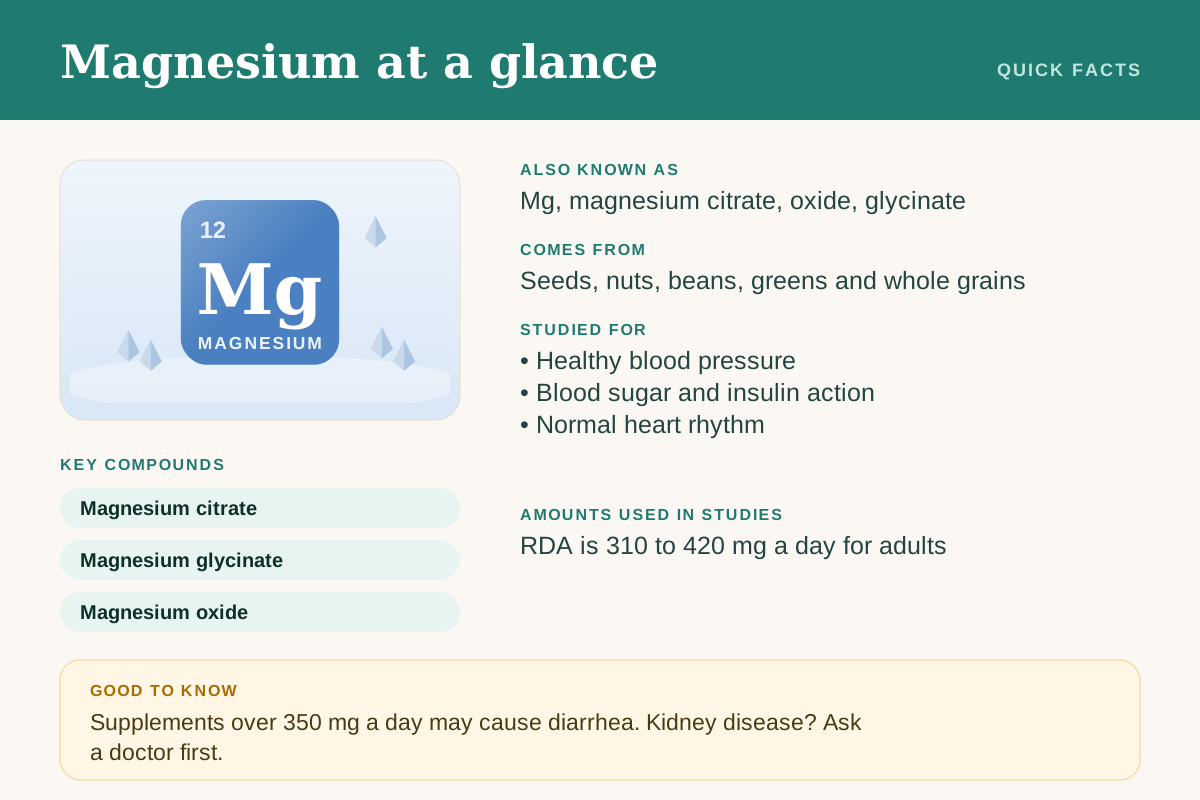
There is also an upper limit of 350 mg a day for magnesium from supplements and medicines in adults. This limit does not apply to magnesium in food, because the kidneys remove the extra from food sources easily. Supplements above that amount are more likely to cause diarrhea and stomach cramps.
Food sources of magnesium
Magnesium is found mostly in plant foods: seeds, nuts, beans, leafy greens and whole grains. Green vegetables get their color from chlorophyll, and every chlorophyll molecule has a magnesium atom at its center. Refining grains strips away much of the magnesium, so whole wheat bread and brown rice supply more than white versions.
| Food | Serving | Approximate magnesium |
|---|---|---|
| Pumpkin seeds, roasted | 1 ounce | 156 mg |
| Chia seeds | 1 ounce | 111 mg |
| Almonds, dry roasted | 1 ounce | 80 mg |
| Spinach, boiled | 1/2 cup | 78 mg |
| Cashews, dry roasted | 1 ounce | 74 mg |
| Black beans, cooked | 1/2 cup | 60 mg |
| Edamame, shelled and cooked | 1/2 cup | 50 mg |
| Peanut butter | 2 tablespoons | 49 mg |
| Brown rice, cooked | 1/2 cup | 42 mg |
A handful of pumpkin seeds on a salad, a bowl of black bean soup and a side of spinach would cover a good share of a day's needs. Bananas, avocado, potatoes with the skin, yogurt and salmon add smaller amounts. Tap water and mineral water can supply some too, depending on where you live.
Here is how an ordinary day of eating can add up. Oatmeal topped with a tablespoon of chia seeds at breakfast, a spinach salad with chickpeas and a sprinkle of pumpkin seeds at lunch, a small handful of almonds in the afternoon, and salmon with brown rice and steamed greens at dinner would bring most adults close to their RDA without any supplement. Swapping white bread and white rice for whole grain versions is one of the simplest changes, since the bran and germ removed in refining carry much of the grain's magnesium.
Magnesium and blood pressure
Blood pressure is the area where magnesium has been studied the most for heart health. Magnesium helps the smooth muscle in artery walls relax, and it works alongside potassium and calcium in keeping blood vessels flexible. The DASH eating plan, which is often recommended for healthy blood pressure, is built around fruits, vegetables, nuts, beans and low-fat dairy, all foods that supply magnesium and potassium.
Clinical trials of magnesium supplements have produced modest results. When researchers pool these trials in meta-analyses, supplements lower blood pressure by a small amount on average, roughly a couple of points in both the top and bottom numbers. The effect seems larger in people who started with low magnesium levels or insulin resistance. In 2022, the FDA allowed a qualified health claim stating that diets with adequate magnesium may reduce the risk of high blood pressure, while noting that the evidence is inconsistent and inconclusive. So magnesium is a sensible part of a heart-friendly diet, and it works best together with other healthy habits.
Magnesium, blood sugar and heart health
Magnesium helps insulin do its job of moving glucose into cells. In large population studies, people who eat more magnesium tend to have a lower risk of type 2 diabetes. People who already have type 2 diabetes often have low magnesium levels, partly because high blood sugar makes the kidneys lose more of it in urine. Some small trials found that supplements improved insulin sensitivity in people who were low in magnesium to begin with, though results are not consistent across studies.
For the heart, magnesium helps keep a normal rhythm, since heart muscle cells depend on it to manage the flow of potassium and calcium. Observational studies have linked higher magnesium intake and higher blood levels with lower rates of heart disease and stroke. Those studies show an association and can't prove that magnesium itself caused the difference, but they fit with what is known about how the mineral works.
Who may run low
Severe magnesium deficiency is uncommon in healthy people because the kidneys hold on to magnesium when intake is low. A low intake over many years is more common, and some groups are more likely to fall short:
- Older adults, who tend to eat less, absorb less from the gut and lose more through the kidneys
- People with type 2 diabetes
- People with digestive conditions such as Crohn's disease or celiac disease
- People who drink alcohol heavily
- People who take certain medicines for long periods, including some diuretics and proton pump inhibitors for heartburn
Early signs of low magnesium can be vague, such as tiredness, weakness, poor appetite or nausea. Muscle cramps, tingling and an irregular heartbeat can appear when levels drop further. A doctor can check your magnesium if you are concerned.
Supplement forms
Magnesium supplements come in many forms, including magnesium oxide, citrate, glycinate, chloride, lactate, aspartate and sulfate. Forms that dissolve well in liquid, such as citrate, chloride, lactate and aspartate, are absorbed better than magnesium oxide and sulfate in small studies. Magnesium oxide packs more magnesium into each pill but is absorbed less, and along with citrate it has a mild laxative effect at higher doses. Many people find that splitting the dose and taking it with food is easier on the stomach.
Safety and who should ask a doctor
Magnesium from food is safe for healthy people. Supplements are also safe for most adults when they stay within the upper limit of 350 mg a day, with diarrhea, nausea and cramps being the usual signs of too much. Very large amounts, usually from laxatives or antacids, can cause dangerous magnesium levels, especially when kidney function is reduced.
- People with kidney disease should not take magnesium supplements unless a doctor recommends them, because the kidneys may not clear the extra.
- Magnesium can reduce absorption of some antibiotics (tetracyclines and quinolones) and of bisphosphonates for osteoporosis, so these need to be taken a few hours apart. Your pharmacist can tell you the right timing.
- Some diuretics raise magnesium loss while others lower it, so ask your doctor if you take water pills.
- If you are pregnant, follow the RDA and talk with your doctor before adding a supplement on top of a prenatal vitamin.
Why it's in the ColestZen formula
The ColestZen formula combines herbs, vitamins and minerals studied for heart, blood sugar and metabolic health. Magnesium covers several of those areas at once: it supports normal blood pressure, helps insulin move glucose into cells and keeps heart muscle working with a steady rhythm. Because many adults over 35 eat less than the RDA, it makes sense as a supporting mineral in a formula aimed at that age group.
It pairs naturally with other ingredients in the blend. Chromium is another mineral involved in insulin action, and taurine shares magnesium's job of managing calcium in heart muscle cells. The brand doesn't list the amount of magnesium per capsule, so if you already take a magnesium supplement or a multivitamin, it is worth mentioning ColestZen to your doctor so your total stays sensible. You can read how the whole blend works in our full ColestZen review.
Frequently asked questions
How much magnesium do adults need each day?
Adult men need 400 to 420 mg a day and adult women need 310 to 320 mg a day, depending on age. During pregnancy the RDA is 350 to 360 mg. Supplements and medicines should not go over 350 mg a day unless a doctor advises it.
What foods are highest in magnesium?
Pumpkin seeds, chia seeds, almonds, cashews, cooked spinach, black beans, edamame, peanut butter and brown rice are all good sources. One ounce of roasted pumpkin seeds provides about 156 mg.
Can magnesium help with blood pressure?
Magnesium has been studied for blood pressure, and pooled trials show small average reductions, often larger in people who were low in magnesium. It works best as part of a healthy diet such as the DASH plan, alongside any treatment your doctor recommends.
Which form of magnesium is best absorbed?
Forms that dissolve well, such as magnesium citrate, chloride, lactate and aspartate, are absorbed better than magnesium oxide in small studies. Magnesium oxide and citrate can loosen stools at higher doses.
Sources
- NIH Office of Dietary Supplements: Magnesium fact sheet for health professionals
- NIH Office of Dietary Supplements: Magnesium fact sheet for consumers
- MedlinePlus: Magnesium in diet
- NHLBI: DASH eating plan
This guide is for general information and is not medical advice. Talk to your doctor before starting any supplement, especially if you take medication.