Manganese is easy to confuse with magnesium, and many people have never given it a second thought. It is a different mineral, needed in much smaller amounts, and it helps your body make energy from food, build bone and protect cells inside their power plants, the mitochondria.
In this guide you'll learn what manganese is, how it works, what it has been studied for, where to find it in food, how much adults need, the safe upper limit, and why it is one of the minerals in ColestZen.
What manganese is
Manganese is an essential trace mineral. Your body holds only a small amount, mostly in the bones, liver, kidneys and pancreas, and it can't make any on its own, so it has to come from food. Only a small share of the manganese you eat is absorbed, and the liver carefully controls how much is kept and how much leaves through bile.
The name sounds a lot like magnesium, and both minerals were named after the same region of ancient Greece, Magnesia. They do different jobs, though. You need hundreds of milligrams of magnesium a day but only about 2 mg of manganese. ColestZen contains both, so it helps to keep them apart.
In supplements, manganese usually appears as manganese gluconate, manganese sulfate, manganese citrate or a chelate such as manganese bisglycinate.
How manganese works in the body
Manganese is a cofactor, meaning certain enzymes need it attached before they can work. Some of the most important ones:
- Manganese superoxide dismutase (MnSOD) is the main antioxidant enzyme inside mitochondria. It turns a harmful oxygen molecule called superoxide into less reactive compounds, which helps protect cells from oxidative stress.
- Pyruvate carboxylase helps the liver make glucose between meals, part of how the body keeps blood sugar steady overnight.
- Arginase helps the liver clear ammonia from protein breakdown through the urea cycle.
- Glycosyltransferases help build the cartilage and connective tissue that bones and joints rely on.
Manganese also helps with blood clotting, together with vitamin K, and with the normal metabolism of carbohydrates, amino acids and cholesterol.
What manganese has been studied for
Blood sugar and metabolic health
Because manganese is part of enzymes that handle glucose, scientists have explored how manganese status relates to blood sugar. In animal studies, low manganese has been tied to poor glucose tolerance. Human research is limited and mostly observational, which means it looks at patterns in large groups and can't show cause and effect. The NIH Office of Dietary Supplements notes that more research is needed before we know whether manganese intake affects the risk of type 2 diabetes. For now, manganese is best described as part of the toolkit your body uses for normal glucose metabolism.
Antioxidant defense and heart health
The MnSOD enzyme is a big reason manganese gets attention in heart and metabolic research. Oxidative stress is one of the processes researchers study in blood vessel health, and MnSOD is a front-line defense in the mitochondria. Studies on manganese intake and blood fats or heart health in people are still early.
Bone health
Manganese is needed to form bone and cartilage. Some studies have tested manganese together with calcium, zinc and copper in older women, and found possible benefits for bone density. Because the minerals were given together, it is hard to say how much was due to manganese alone.
Food sources of manganese
Whole grains, nuts, legumes, leafy greens, tea and shellfish supply most of the manganese in a typical diet. Values below are approximate and based on the NIH Office of Dietary Supplements food list.
| Food | Serving | Manganese (approx.) |
|---|---|---|
| Mussels, cooked | 3 ounces | 5.8 mg |
| Hazelnuts, dry roasted | 1 ounce | 1.6 mg |
| Pecans, dry roasted | 1 ounce | 1.1 mg |
| Brown rice, cooked | 1/2 cup | 1.1 mg |
| Chickpeas, cooked | 1/2 cup | 0.9 mg |
| Spinach, boiled | 1/2 cup | 0.8 mg |
| Pineapple, raw chunks | 1/2 cup | 0.8 mg |
| Black tea, brewed | 1 cup | about 0.5 mg |
A bowl of oatmeal topped with a few chopped pecans and some pineapple gets you a good part of the day's manganese before lunch. Iron and manganese use some of the same absorption routes, so people with low iron tend to absorb more manganese, and high iron intake can lower manganese absorption. Calcium and phytates in grains and beans can also reduce how much is absorbed a little, which is one reason the body's own regulation matters so much.
How much manganese adults need
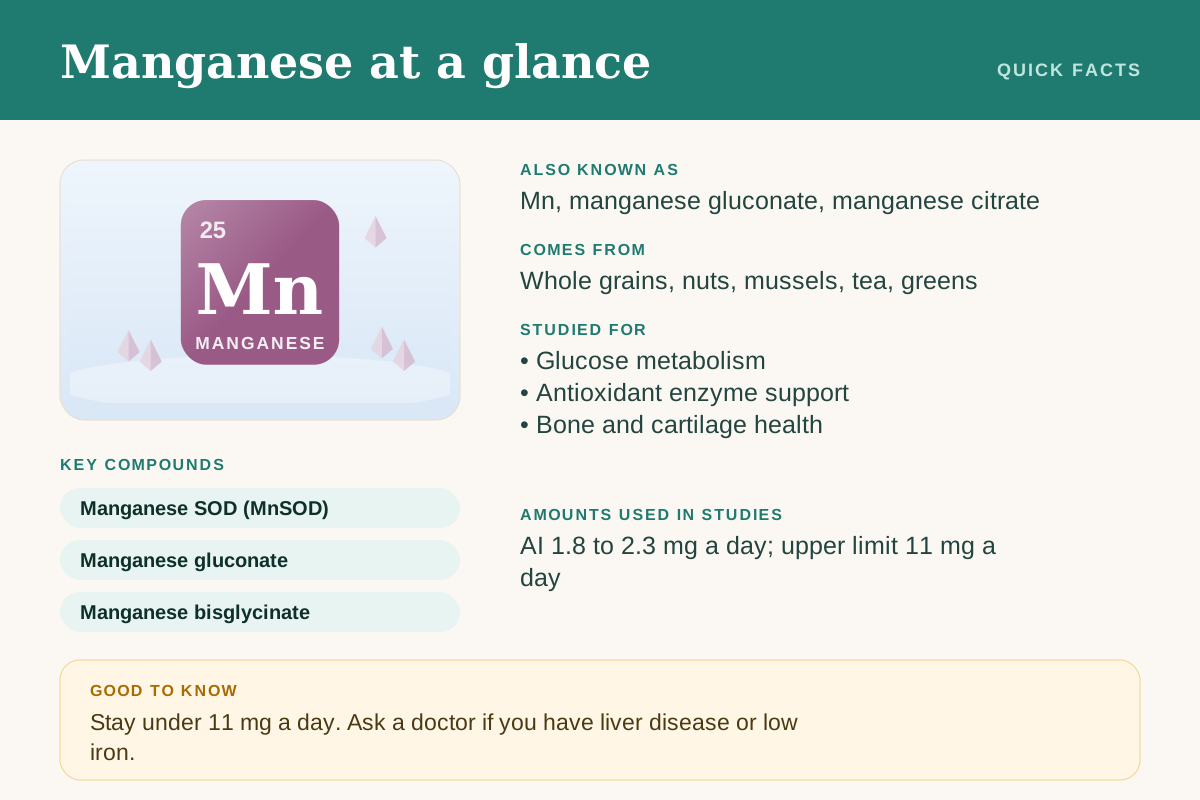
There isn't enough data to set an RDA for manganese, so experts use an Adequate Intake (AI). For adults 19 and older the AI is 2.3 mg a day for men and 1.8 mg a day for women. During pregnancy it is 2 mg, and while breastfeeding it is 2.6 mg.
The Tolerable Upper Intake Level (UL) for adults is 11 mg a day. Most American adults get enough from a normal diet, and true manganese deficiency is very rare. It has mostly been seen in research settings where people were fed a diet with almost no manganese.
Research on manganese alone in people is limited, and it has often been given in combination with other minerals. Supplement amounts in multivitamins and mineral blends usually stay around the AI, well below the upper limit.
Signs of too little or too much manganese
Because manganese is in so many plant foods, running short is unusual for anyone who eats whole grains, beans, nuts or tea. In the few controlled studies where volunteers ate a diet with very little manganese, researchers saw skin rashes, changes in mood and changes in cholesterol levels. In animals, low manganese has been tied to weak bones, poor growth and trouble handling glucose.
Too much manganese is the bigger concern, but it almost never comes from food. The body absorbs only a small share of what you eat and sends the extra out through bile. Problems show up when that system is bypassed or overwhelmed, for example with long-term breathing of manganese dust, very high levels in drinking water, or liver disease that slows clearance. Early signs can include tremors, muscle stiffness, irritability and trouble with balance, so anyone with those symptoms and a possible exposure should see a doctor.
For most adults, the takeaway is reassuring. A varied diet covers your needs, and a supplement that stays near the AI is a small, steady top-up.
Safety and who should ask a doctor
Manganese from food is safe for healthy people. Most cases of manganese toxicity have come from breathing manganese dust or fumes at work, for example in mining and welding, which can harm the nervous system. Very high amounts in well water can also be a concern in some areas, so it is worth checking a private well report.
Talk with your doctor or pharmacist before taking a supplement with manganese if you:
- Have liver disease, because the liver is how the body clears extra manganese.
- Have iron deficiency anemia, since low iron increases manganese absorption.
- Take quinolone or tetracycline antibiotics, or antacids and laxatives that contain magnesium, which can affect how minerals are absorbed. Spacing doses a few hours apart is usually advised.
- Have diabetes and take blood sugar medicine, since ColestZen includes several ingredients studied for blood sugar support.
- Are pregnant or breastfeeding.
It also makes sense to count manganese from all your supplements, including multivitamins and joint formulas, so your total stays below 11 mg a day.
Why manganese is in ColestZen
ColestZen combines plant extracts like cinnamon bark, bitter melon and gymnema with a set of minerals and vitamins the body uses for healthy metabolism. Manganese fits that picture neatly. It is part of the enzyme that helps the liver make glucose between meals, and it powers MnSOD, the main antioxidant enzyme inside your mitochondria. It works next to zinc, chromium and magnesium in the formula, each covering a different part of how the body handles energy.
The brand doesn't publish the manganese amount per capsule, so we can't state a ColestZen dose. For the full ingredient list, our rating and the details on the 60-day money-back guarantee, see our full ColestZen review.
As always, a supplement works best on top of a good diet. Whole grains, a handful of nuts, beans and leafy greens will keep your manganese in a healthy range.
Frequently asked questions
Is manganese the same as magnesium?
No. They are two different minerals with similar names. Adults need hundreds of milligrams of magnesium a day but only around 2 mg of manganese. ColestZen contains both.
How much manganese do adults need?
The Adequate Intake is 2.3 mg a day for men and 1.8 mg a day for women, 2 mg during pregnancy and 2.6 mg while breastfeeding. The upper limit for adults is 11 mg a day from all sources.
What foods are high in manganese?
Mussels, hazelnuts, pecans, brown rice, oatmeal, chickpeas, spinach, pineapple, whole wheat bread and black tea are all good sources.
Who should be careful with manganese supplements?
People with liver disease or iron deficiency anemia, people taking certain antibiotics or magnesium antacids, and anyone pregnant or breastfeeding should ask their doctor first. Keep your total from all supplements under 11 mg a day.
Sources
- NIH Office of Dietary Supplements: Manganese fact sheet for health professionals
- MedlinePlus: Manganese
- Linus Pauling Institute Micronutrient Information Center: Manganese
This guide is for general information and is not medical advice. Talk to your doctor before starting any supplement, especially if you take medication.