If you grew up near an old mulberry tree, you probably remember purple-stained fingers and sidewalks every June. Mulberries look a bit like long blackberries, taste sweet and slightly tart, and spoil so quickly that they rarely show up in grocery stores. Today most people meet them dried, frozen or as a fine purple powder.
The mulberry tree is interesting to researchers for two different reasons. Its leaves have been studied for blood sugar, while its fruit has been studied mainly for its colorful antioxidants. ColestZen uses mulberry fruit powder, so this article focuses on the berry, explains how it differs from the leaf, and covers safety and why it was included in the formula.
What mulberry fruit is
Mulberries grow on trees in the genus Morus. Three species are the most familiar. White mulberry (Morus alba) comes from China and has been grown there for thousands of years, mostly because silkworms feed on its leaves. Black mulberry (Morus nigra) is native to southwest Asia and has the deepest flavor. Red mulberry (Morus rubra) is native to the eastern United States, and you can still find it at the edges of woods and in older neighborhoods.
White mulberry reached America early. Colonists in Virginia were encouraged to plant it in hopes of starting a silk industry, and a second wave of planting swept parts of the country in the 1830s. The silk business never took off, but the trees stayed, which is why so many backyards and city parks still have a mulberry tree that drops fruit every summer. White and red mulberries also cross easily, so many wild American trees today are hybrids.
Despite the names, the color of the fruit does not always match the species. White mulberry trees can produce white, pink, red or nearly black berries. Each berry is a cluster of tiny fruits joined together, which gives it that bumpy, blackberry-like look, and a short green stem stays attached when you pick it.
Mulberry fruit and mulberry leaf are different
This point causes a lot of confusion online, so it is worth getting clear. Most of the human research on mulberry and blood sugar was done with mulberry leaf extract. The leaves contain a compound called 1-deoxynojirimycin, usually shortened to DNJ, which slows the enzymes in your gut that break carbohydrates down into glucose. In small human studies, mulberry leaf extract taken with a starchy meal tended to reduce the rise in blood sugar afterward.
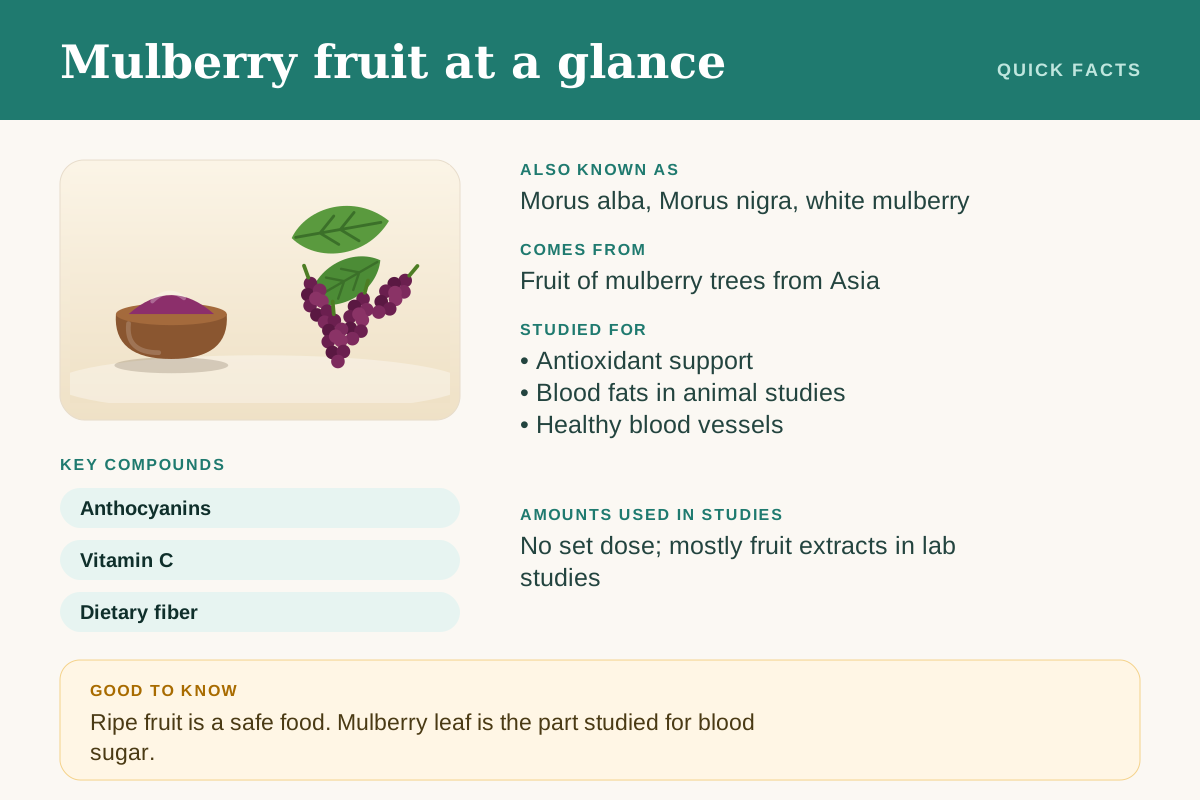
The fruit is a different part of the plant with a different profile. It is mostly water and natural sugars, with fiber, vitamin C, iron and a large amount of anthocyanins, the pigments that make the berries dark purple. Research on the fruit has looked mainly at these antioxidants and their effects on blood fats, oxidative stress and inflammation, much of it in lab and animal studies.
| Mulberry leaf | Mulberry fruit | |
|---|---|---|
| Main compounds | DNJ, flavonoids such as quercetin | Anthocyanins, vitamin C, fiber |
| Main research focus | Post-meal blood sugar in humans | Antioxidant activity and blood fats, mostly lab and animal |
| Traditional use | Tea in China, Japan and Korea | Fresh fruit, jams, wine and dried snacks |
| Form in ColestZen | Not used | Fruit powder |
So when you read that mulberry has been studied for blood sugar, keep in mind that this usually means the leaf. The fruit brings its own strengths, which fit a heart and metabolic formula in a different way.
Nutrition and food sources
Fresh mulberries are low in calories, with roughly 60 calories in a cup of raw berries. They are a good source of vitamin C and contain more iron than most fruits, along with potassium, vitamin K and some fiber. Dried mulberries are sweeter and more concentrated, and they are often sold next to raisins and goji berries as a snack.
In Turkey and Iran, mulberries are boiled down into a thick syrup called pekmez or dried into chewy sheets. In China, the fruit has been used in traditional recipes and teas for centuries, and in parts of Europe black mulberries go into jams, pies and fruit wine. If you have a tree nearby, freezing the ripe berries is the easiest way to keep them, since fresh ones only last a day or two in the fridge.
What mulberry fruit has been studied for
Anthocyanins are the same family of pigments found in blueberries, blackberries and purple grapes. In general, diets high in deeply colored fruits and vegetables are linked with better heart health in large population studies. Mulberries are one of the more concentrated sources of anthocyanins, especially cyanidin-3-glucoside.
Researchers have tested mulberry fruit extracts in animals fed high-fat diets and found improvements in blood fats, such as triglycerides and LDL cholesterol, as well as lower markers of oxidative stress. Lab studies suggest mulberry anthocyanins may help protect LDL particles from oxidation, which matters because oxidized LDL is the form most involved in the buildup of plaque in artery walls. Other lab work has looked at how the fruit's compounds affect fat cells and how they handle sugar.
Human research on the fruit itself is limited and early. That means mulberry fruit is best described as a nutritious berry that may support heart and metabolic health as part of a balanced diet, with promising lab and animal results that still need to be confirmed in people.
How the antioxidants may work
Every day, normal processes in your body produce unstable molecules called free radicals. When there are more of them than your body can neutralize, the result is oxidative stress, which can damage cells and the lining of blood vessels over time. Anthocyanins and vitamin C help neutralize free radicals.
Anthocyanins also appear to support the cells that line your blood vessels, which release nitric oxide to help vessels relax. Some research suggests they may influence how the liver processes fats. Your body breaks most anthocyanins down quickly, and scientists are still studying which breakdown products do the most work. This is one reason researchers prefer to study whole fruit and fruit powders, which keep the natural mix of compounds together.
Amounts used in studies
There is no standard dose of mulberry fruit. In animal research, scientists used fruit extracts or freeze-dried powder at amounts that are hard to translate into human servings. As a food, a cup of fresh berries or a small handful of dried ones is a typical portion. Mulberry leaf studies in people used concentrated leaf extracts taken with meals, and those amounts do not apply to fruit powder.
ColestZen does not publish how much of each ingredient is in a capsule. The fruit powder is one of 18 ingredients in a two-capsule daily serving.
Safety and who should ask a doctor
Ripe mulberries are a common food and are safe for most people in normal amounts. A few practical points:
- Eat only ripe berries. Unripe mulberries and the milky sap of the tree can upset the stomach.
- People with a known allergy to mulberries or to related plants such as figs should avoid them.
- Mulberry leaf extract may lower blood sugar. Several ingredients in ColestZen are studied for blood sugar, so if you take diabetes medication, ask your doctor before starting any blood sugar supplement.
- If you are pregnant or breastfeeding, eating mulberries as food is fine, but check with your doctor before taking concentrated supplements.
As with any supplement, bring the bottle to your next checkup so your doctor can see the full list of ingredients alongside your current medicines.
Why mulberry fruit is in the ColestZen formula
ColestZen combines 18 ingredients aimed at healthy cholesterol, blood sugar and overall metabolic health. Mulberry fruit powder adds a concentrated source of anthocyanins to the blend. It works alongside other antioxidants in the formula, such as vitamin C, vitamin E and alpha lipoic acid, while ingredients like banaba leaf, gymnema sylvestre and chromium focus on blood sugar.
Choosing the fruit gives the formula a food-based antioxidant that people have eaten safely for centuries, which suits a supplement meant for daily use. To see the whole ingredient list, how the capsules are taken, pricing and the 60-day money-back guarantee, read our full ColestZen review.
Easy ways to enjoy mulberries
If you would like more mulberries in your diet, dried berries are the easiest place to start. Toss a spoonful into oatmeal or plain yogurt, mix them into trail mix with walnuts and almonds, or stir mulberry powder into a smoothie with spinach and a banana. Frozen mulberries make a quick sauce for whole grain pancakes when simmered for a few minutes with a squeeze of lemon. Pairing the berries with nuts or yogurt adds protein and healthy fat, which helps the natural sugars reach your bloodstream more slowly.
Frequently asked questions
Is mulberry fruit the same as mulberry leaf?
No. They come from the same tree but have different compounds. Most blood sugar research used mulberry leaf extract, which contains DNJ. The fruit is studied mainly for its anthocyanin antioxidants. ColestZen uses mulberry fruit powder.
What are the health benefits of mulberry fruit?
Mulberries provide vitamin C, iron, fiber and anthocyanins. Lab and animal studies suggest the fruit may support healthy blood fats and help protect cells from oxidative stress. Human research on the fruit is still limited.
Are mulberries safe to eat every day?
Ripe mulberries are safe for most people as part of a normal diet. Avoid unripe berries, which can upset the stomach, and skip them if you have a mulberry or fig allergy.
How much mulberry is in ColestZen?
The brand does not publish the amount of each ingredient per capsule. Mulberry fruit powder is one of 18 ingredients in the two-capsule daily serving.
Sources
- USDA FoodData Central: Mulberries, raw
- Memorial Sloan Kettering Cancer Center, About Herbs: Mulberry
- NCCIH: Diabetes and dietary supplements
- Published lab, animal and small human studies on mulberry fruit and mulberry leaf
This guide is for general information and is not medical advice. Talk to your doctor before starting any supplement, especially if you take medication.