Vitamin E is the antioxidant that lives in your cell membranes. It is found in nuts, seeds and plant oils, and its main job is to protect the fats in your body, including the cholesterol carried in your blood, from oxidative damage.
This guide explains what vitamin E is, what it has been studied for, how much adults need and which foods supply the most. It also covers who should be careful with supplements, especially people on blood thinners, and why vitamin E is one of the 18 ingredients in ColestZen.
What vitamin E is
Vitamin E is a fat-soluble vitamin, so it is absorbed along with the fat in your meals and stored in your liver and fatty tissue. It was discovered in the 1920s by researchers studying a factor in vegetable oils, and the name tocopherol comes from Greek words meaning to bear offspring, because early experiments tied it to fertility in rats.
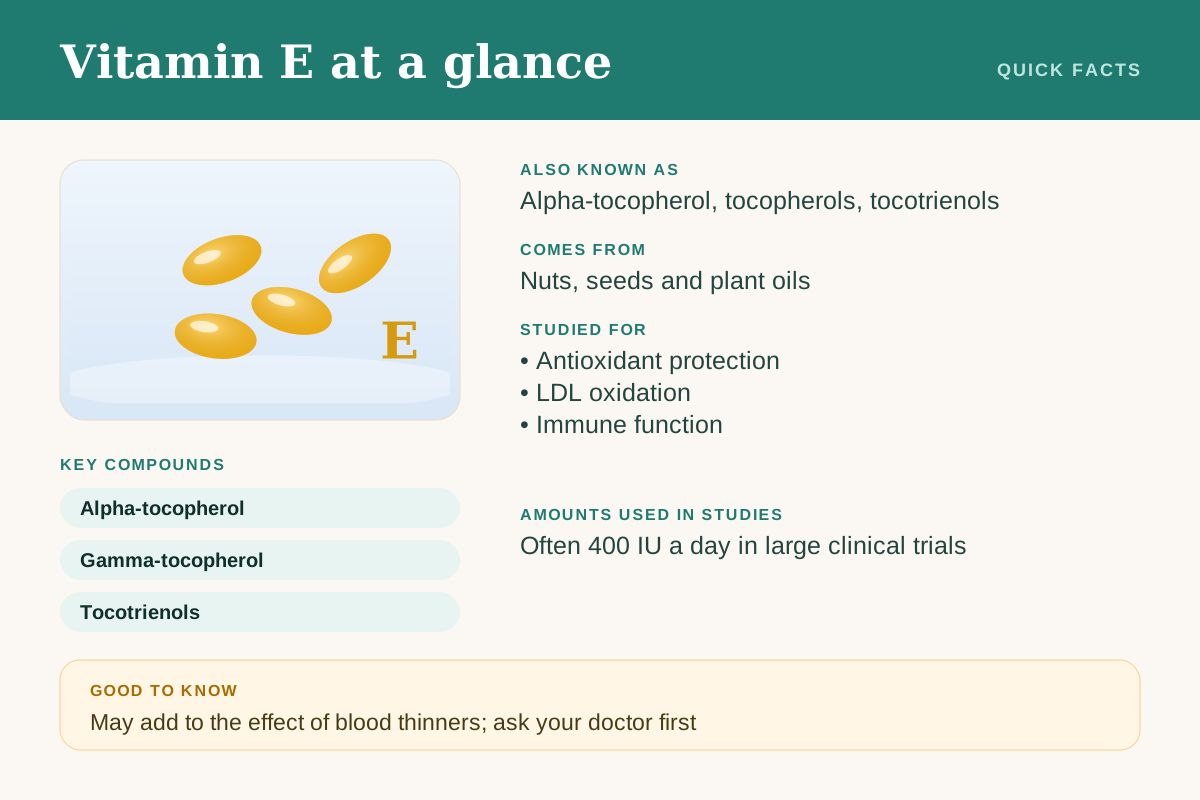
The name vitamin E actually covers a family of eight related compounds: four tocopherols and four tocotrienols, each labeled alpha, beta, gamma or delta. Alpha-tocopherol is the only form your body actively keeps in the blood, and it is the form used to set dietary requirements. Gamma-tocopherol is the most common form in the American diet, because soybean and corn oils contain a lot of it.
On supplement labels you will see natural vitamin E written as d-alpha-tocopherol and the synthetic version written as dl-alpha-tocopherol. The natural form is more active in the body, so you need a smaller amount of it to get the same effect.
Vitamin E as an antioxidant
Every cell in your body is wrapped in a membrane made largely of fats. Those fats are easily damaged by free radicals, unstable molecules produced during normal metabolism and from things like cigarette smoke, air pollution and ultraviolet light. Vitamin E sits inside those membranes and stops the chain reaction that free radicals start, protecting the fats around it.
The same protection applies to the fats traveling in your bloodstream. LDL cholesterol particles carry vitamin E, and in laboratory studies vitamin E slows the oxidation of LDL. Oxidized LDL is one of the steps in plaque formation, which is why vitamin E attracted so much attention from heart researchers.
Vitamin E does not work alone. After it neutralizes a free radical, vitamin C can help restore it to its active form, so the two vitamins act as a team.
Other roles in the body
Beyond its antioxidant work, vitamin E helps the immune system respond normally, which matters more as we age. It is involved in cell signaling and in the activity of certain genes. It also helps blood vessels widen and slows the clumping of platelets, the blood cells that form clots. That last effect is the reason people on blood thinners need to be careful with high dose supplements, as the safety section explains.
What vitamin E has been studied for
Heart health
Because of its role in protecting LDL cholesterol, vitamin E was one of the most studied supplements for heart health in the 1990s and 2000s. Observational studies found that people with higher vitamin E intakes, mostly from food, tended to have healthier hearts. When large clinical trials gave people vitamin E supplements, though, most did not find fewer heart attacks, strokes or deaths from heart disease. Vitamin E supplements are not recommended as a way to protect against heart attacks.
The more useful takeaway is that vitamin E is part of the body's normal antioxidant defense system, and getting enough of it from food supports that system. Eating nuts, seeds and plant oils in place of foods high in saturated fat is also part of most heart healthy eating patterns.
Eye health
A large NIH study on age-related macular degeneration, the Age-Related Eye Disease Study (AREDS), used a combination of vitamin E, vitamin C, zinc and other nutrients. In people with intermediate or advanced macular degeneration in one eye, the combination slowed progression of the disease. Vitamin E was one part of that blend, so its effect on its own is not clear.
Aging and immune function
Some studies in older adults have looked at whether vitamin E supports immune responses and healthy aging of the brain. Results have been mixed, and research continues.
How much vitamin E you need
The Recommended Dietary Allowance (RDA) for vitamin E is given in milligrams of alpha-tocopherol. Many labels still list international units (IU), so the conversion is shown below.
| Group | Daily amount |
|---|---|
| Adults 19 and older | 15 mg (22.4 IU natural or 33.3 IU synthetic) |
| Pregnancy | 15 mg |
| Breastfeeding | 19 mg |
| Upper limit for adults (supplements) | 1,000 mg (1,500 IU natural or 1,100 IU synthetic) |
The Daily Value on US labels is 15 mg. Many Americans get less than the RDA from food alone, but true deficiency is rare in healthy people. It mostly shows up in people who cannot absorb fat properly, such as those with Crohn's disease or cystic fibrosis, and it can cause nerve and muscle problems.
Best food sources of vitamin E
Nuts, seeds and vegetable oils are the best sources, and green vegetables add smaller amounts. Because vitamin E is fat soluble, eating these foods as part of a meal with some fat helps absorption.
| Food | Serving | Vitamin E |
|---|---|---|
| Wheat germ oil | 1 tablespoon | About 20 mg |
| Sunflower seeds, dry roasted | 1 ounce | About 7.4 mg |
| Almonds, dry roasted | 1 ounce | About 6.8 mg |
| Sunflower oil | 1 tablespoon | About 5.6 mg |
| Hazelnuts, dry roasted | 1 ounce | About 4.3 mg |
| Peanut butter | 2 tablespoons | About 2.9 mg |
| Spinach, boiled | Half a cup | About 1.9 mg |
| Broccoli, boiled | Half a cup | About 1.2 mg |
A small handful of almonds plus a tablespoon of sunflower oil in a salad dressing gets you most of the way to 15 mg. Kiwifruit, mango and tomatoes contribute a little too.
Amounts used in studies
Large clinical trials have usually tested amounts far above the RDA, commonly around 400 IU a day, and some used 600 IU every other day. These doses were chosen to test whether high intakes could change long term health outcomes, which is different from meeting everyday needs.
For most adults, the sensible approach is to cover the RDA through food and, if you use a supplement, to keep the total amount moderate and below the upper limit unless a doctor advises otherwise.
Safety and who should talk to a doctor
Vitamin E from food is safe for everyone. Supplements are well tolerated at normal amounts, but high doses carry some risks that are worth knowing about.
- If you take a blood thinner such as warfarin, or an antiplatelet medicine such as clopidogrel or daily aspirin, talk to your doctor before taking vitamin E supplements. Vitamin E may add to their effect and raise the risk of bleeding.
- Because of that same effect on clotting, many surgeons ask patients to stop vitamin E supplements before an operation.
- If you are having chemotherapy or radiation therapy, check with your cancer care team before taking antioxidant supplements.
- People taking a statin together with niacin for cholesterol should mention antioxidant supplements to their doctor, as the combination has been studied for possible interactions.
If you are pregnant or breastfeeding, a prenatal vitamin and a normal diet usually cover your needs. As with any supplement, share your full list with your doctor or pharmacist, especially if you take prescription medicine.
Why vitamin E is in ColestZen
ColestZen is built to support heart and metabolic health, and vitamin E brings antioxidant support to the blend. It protects the fats in cell membranes and in your blood, and it works hand in hand with vitamin C, which is also in the formula. Together with alpha lipoic acid, another antioxidant in ColestZen, it helps round out the formula's antioxidant side, while ingredients such as cinnamon bark, chromium and bitter melon cover blood sugar support.
The brand does not publish how much vitamin E each capsule contains, so we cannot compare it to the RDA or to trial doses. If you take a blood thinner, show the label to your doctor before you start. To see how the full formula did, along with the price and the 60-day money-back guarantee, read our full ColestZen review.
A handful of nuts or seeds most days is still one of the easiest ways to get vitamin E, and it brings fiber and healthy fats along with it.
Frequently asked questions
How much vitamin E do adults need?
The RDA for adults is 15 mg of alpha-tocopherol a day, which equals about 22.4 IU of natural vitamin E or 33.3 IU of synthetic. Breastfeeding women need 19 mg. The upper limit from supplements is 1,000 mg a day.
What foods are high in vitamin E?
Wheat germ oil, sunflower seeds, almonds, sunflower oil and hazelnuts are the top sources. Peanut butter, spinach and broccoli add smaller amounts.
Can I take vitamin E with blood thinners?
Talk to your doctor first. Vitamin E can slow blood clotting, so taking it with warfarin, clopidogrel, aspirin or similar medicines may raise the risk of bleeding.
How much vitamin E is in ColestZen?
The brand does not list the amount of each ingredient per capsule. Vitamin E is one of 18 ingredients in the blend, which is taken as 2 capsules a day.
Sources
- NIH Office of Dietary Supplements: Vitamin E fact sheet for health professionals
- Food and Nutrition Board, National Academies: Dietary Reference Intakes for Vitamin C, Vitamin E, Selenium, and Carotenoids (2000)
- National Eye Institute: Age-Related Eye Disease Study (AREDS)
- MedlinePlus: Vitamin E
This guide is for general information and is not medical advice. Talk to your doctor before starting any supplement, especially if you take medication.