If you have walked along a country road or an open meadow in summer, you have probably passed yarrow without a second look. It has flat clusters of tiny white flowers and soft, feathery leaves, and it grows almost everywhere in the northern half of the world.
Yarrow is also one of the oldest medicinal plants on record. Healers in Europe, Asia and North America used it for cuts, fevers and upset stomachs for centuries. Modern research on yarrow in people is still limited, so this article sticks to what is known: its history, the compounds inside it, what scientists have started to look at, and how to use it safely.
What yarrow is
Yarrow is a flowering perennial with the botanical name Achillea millefolium. It belongs to the daisy family (Asteraceae), the same family as chamomile, ragweed and sunflowers. The plant usually grows one to three feet tall. Each stem ends in a flat-topped cluster of small flowers, most often white, though garden varieties come in pink, yellow and red.
The second half of the name, millefolium, means "thousand leaves" in Latin. It describes the fine, finely divided leaves that look almost like feathers or ferns. Crush a leaf between your fingers and you will notice a sharp, slightly sweet smell, a hint of the aromatic oil inside.
Yarrow is native to the temperate parts of Europe, Asia and North America, and it now grows wild across much of the United States. It handles poor soil, drought and mowing, which is why you see it along roadsides, in pastures and in lawns. For herbal products, the flowering tops (the upper stems, leaves and flowers) are gathered in summer and dried.
A long history as a healing plant
Few herbs come with a story as old as yarrow's. The genus name Achillea comes from Achilles, the Greek hero of the Trojan War. According to legend, he used the plant to treat the wounds of his soldiers. Whether or not the story is true, it stuck, and yarrow picked up folk names that tell you how people used it: soldier's woundwort, staunchweed, nosebleed plant and herba militaris.
In medieval and early modern Europe, yarrow was a common garden and hedgerow herb. It was laid on cuts, brewed as a bitter tea for poor appetite and indigestion, and taken hot to bring on a sweat during colds and fevers. In northern Europe it was one of the herbs used to flavour ale before hops became standard.
Native American nations across North America had their own uses. Different groups used yarrow for wounds, toothache, colds and stomach complaints, often as a poultice or a tea. In China, dried yarrow stalks were the traditional tools for consulting the I Ching, the ancient book of divination.
That wide spread of uses across unrelated cultures does not prove the plant works for each purpose. It does show that people on several continents kept coming back to the same herb.
What is inside yarrow
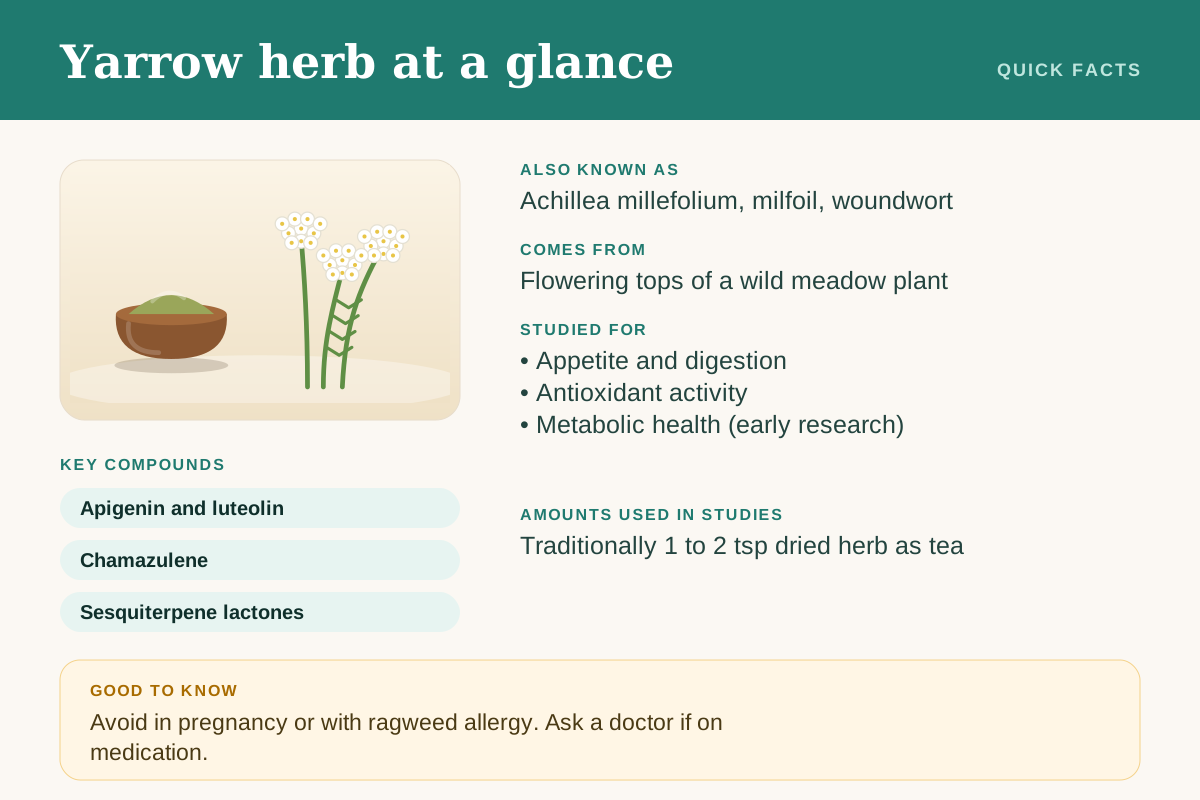
Yarrow contains a mix of natural compounds that researchers think explain its traditional reputation. They include:
- Flavonoids, such as apigenin and luteolin, which are plant antioxidants also found in chamomile and parsley.
- An essential oil that can contain chamazulene, a compound that turns the distilled oil a deep blue.
- Sesquiterpene lactones, bitter compounds common in the daisy family that give yarrow tea its sharp taste.
- Phenolic acids and tannins, which have a mild astringent (tightening) effect.
The exact makeup varies a lot between plants. Where yarrow grows, when it is picked and which subspecies it is can all change how much of each compound it has.
What yarrow has been studied for
Most of the scientific work on yarrow has been done in test tubes and in animals. Human trials are few and small, so it is honest to say the research is at an early stage.
Digestion
Digestive support is the use with the most official recognition. In Germany, the Commission E (an expert panel that reviewed herbal medicines) accepted yarrow for loss of appetite and mild digestive complaints such as bloating and cramping. The European Medicines Agency also lists yarrow as a traditional herbal medicine for minor digestive problems, based on long use rather than clinical trials. The bitter compounds are thought to stimulate digestive juices, the same idea behind old-fashioned bitters.
Antioxidant and soothing effects
Lab studies show yarrow extracts have antioxidant activity and may calm inflammation signals in cells. Since oxidative stress and ongoing inflammation are part of how heart and metabolic problems develop over time, researchers have taken an interest in plants like yarrow. These are early findings, and lab results do not always carry over to the human body.
Blood vessels, blood pressure and blood sugar
A handful of animal studies have looked at yarrow extracts and blood vessel relaxation, blood pressure and blood sugar, with some encouraging results. There is not yet enough human research to say what yarrow does for these measures in people. It is fair to describe yarrow as a traditional herb that may support overall wellness and is being studied for its effects on metabolism.
Skin and minor wounds
Matching its old name, yarrow has been studied in creams and ointments for minor skin problems and wound care. The European herbal monograph lists traditional external use for small superficial wounds.
How yarrow is used and how much
Yarrow is mostly taken as a tea, a liquid extract or a capsule. There are no well established doses from large human trials, so the amounts below come from traditional European herbal practice.
| Form | How it is traditionally used |
|---|---|
| Tea (infusion) | About 1 to 2 teaspoons of dried flowering tops steeped in a cup of hot water, taken between meals |
| Liquid extract or tincture | Small amounts measured by the dropperful, following the label |
| Capsules | Dried herb or extract, usually as part of a blend |
| Creams and washes | Applied to the skin for minor cuts and scrapes |
The tea tastes bitter and a little like sage. Many people add mint, chamomile or a spoon of honey to soften it.
Safety and who should check with a doctor
Yarrow is generally considered safe for most healthy adults when used in normal amounts for short periods. Still, it is a real medicinal plant, and a few groups should be careful.
- People who are allergic to ragweed, chrysanthemums, marigolds, daisies or chamomile may react to yarrow too, since they are all in the same family. Reactions can include skin rash or, rarely, more serious allergy symptoms.
- Women who are pregnant or breastfeeding should avoid yarrow supplements. It was traditionally used to affect the menstrual cycle, and it has not been shown to be safe in pregnancy.
- People taking blood thinners, blood pressure medicine, diabetes medicine or sedatives should ask a doctor or pharmacist first. Yarrow has not been well studied with these drugs, and several ingredients in metabolic formulas can add to the effect of blood sugar medicines.
- Anyone with planned surgery should tell their care team about all herbal supplements.
Applied to the skin, yarrow can occasionally cause irritation or an itchy rash in sensitive people. Stop using it if that happens.
Why yarrow is in the ColestZen formula
ColestZen combines 18 ingredients in a two capsule daily dose aimed at heart and metabolic support. Yarrow brings a long traditional history as a digestive and general wellness herb, along with flavonoids and other antioxidant compounds that researchers are studying for their effects on inflammation and metabolism.
In the blend, yarrow works next to other traditional plants such as juniper berry, licorice root and banaba leaf, plus better studied nutrients like chromium, magnesium and alpha lipoic acid. The brand does not publish the amount of each ingredient per capsule, so the yarrow dose in ColestZen is not known. Its role looks supportive, rounding out the herbal side of the formula.
To see how all 18 ingredients fit together, plus pricing and the 60-day money-back guarantee, read our full ColestZen review.
The bottom line on yarrow
Yarrow is a hardy meadow plant with one of the longest healing histories in Western herbalism, from the Achilles legend to European bitters and Native American wound care. Its best supported traditional use is for appetite and mild digestive upset. Research on heart, blood sugar and metabolic health is still mostly in the lab, so treat it as a gentle supporting herb. Skip it if you are pregnant or allergic to ragweed, and check with your doctor if you take regular medication.
Frequently asked questions
What is yarrow tea good for?
Yarrow tea has traditionally been used for poor appetite, bloating and mild stomach cramps. European herbal authorities recognise it as a traditional remedy for minor digestive complaints, though large human trials are lacking.
Is yarrow safe to take every day?
Most healthy adults tolerate yarrow in normal amounts for short periods. Avoid it if you are pregnant, breastfeeding or allergic to ragweed and daisies, and ask your doctor if you take regular medication.
Why is yarrow named after Achilles?
Its genus name, Achillea, comes from the Greek hero Achilles. Legend says he used the plant on his soldiers' wounds, which is also where folk names like soldier's woundwort come from.
How much yarrow is in ColestZen?
The brand does not list the amount of each ingredient per capsule, so the yarrow dose is not published. It is one of 18 ingredients in a two capsule daily serving.
Sources
- European Medicines Agency: Community herbal monograph on Achillea millefolium L., herba
- German Commission E monographs: Yarrow herb
- MedlinePlus: Yarrow
This guide is for general information and is not medical advice. Talk to your doctor before starting any supplement, especially if you take medication.